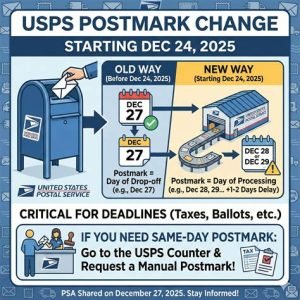
Postmaster General Confirms Plan to Hold Back Mail Ballots Under Proposed Rule

Steve HutkinsBlog, Featured, News

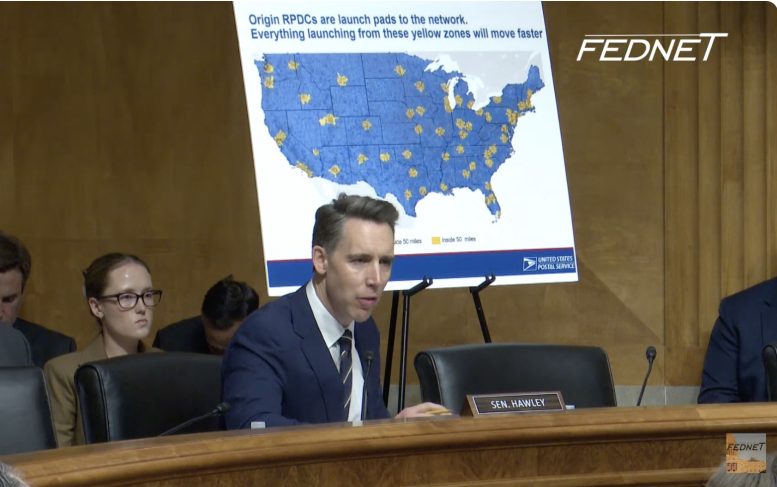
New York Times: Postmaster General David Steiner said at a Senate hearing on Wednesday that under a new proposed rule, the Postal Service would not deliver mail-in ballots in states that decline to hand over sensitive data about voters to the federal government.

The Postal Service’s proposed rule was released this month and is in line with President Trump’s March executive order intended to restrict voting by mail. That order, which faces multiple court challenges, seeks to create state-by-state lists of citizens to help determine who is eligible to vote and calls on the Postal Service not to distribute mail ballots to those not on state lists.

Earlier this year, Mr. Steiner told The New York Times that the Postal Service would defer to the courts on the legality of Mr. Trump’s executive order and that the service would “absolutely” continue to deliver mail-in ballots.

But in his testimony before the Senate Homeland Security Committee on Wednesday, Mr. Steiner said that the proposed rule would in effect halt the delivery of mail-in ballots in states that do not comply with Mr. Trump’s demands.

He was asked by Senator Gary Peters of Michigan, the committee’s top Democrat: “If a state refuses to turn their absentee voter list over to the federal government, will the Postal Service still mail their ballots under this proposal rule?”

“Under our proposed regulation, no,” Mr. Steiner responded.

Mr. Steiner reaffirmed at the hearing that the Postal Service would follow any court orders governing voting by mail.

Withholding some mail services in states where voters rely heavily on mail balloting could affect millions of Americans.

Mr. Trump has tried repeatedly to assert federal control over voting and fiercely opposes voting by mail. He has repeatedly made baseless claims that mail-in ballots allow for widespread election fraud favoring Democrats.

The Postal Service’s proposed rule appears to establish broad authority for the agency to intervene in the vote-by-mail process. It proposes that Postal Service employees screen mail-in ballots for eligibility using lists of voters provided by the states, and it requires states to adhere to new design rules for the ballots….

Democrats fear that the president is using his push to assert control to try to give Republicans an electoral advantage, something Mr. Trump has not denied. At the Senate hearing on Wednesday, they repeatedly accused Mr. Steiner of doing Mr. Trump’s bidding.

“Please push back on being a pawn in this authoritarian playbook,” said Senator Elissa Slotkin, Democrat of Michigan. “The Postal Service is one of the most important institutions in our country. Don’t taint it with the obsession of this one man.”

Read more: Postmaster General Confirms Plan to Hold Back Mail Ballots Under Proposed Rule – The New York Times

Senate Democrats sound alarm over Trump’s Postal Service plans for mail-in ballots

Steve HutkinsBlog, Featured, News

MSNow: Senate Democrats are calling on the U.S. Postal Service not to move ahead with new mail-in ballot regulations that, they say, will “establish President Trump’s control over federal elections.”

In a new letter first shared with MS NOW, all 47 members of the Senate Democratic Caucus warned Postal Service leaders that the proposed changes would “fundamentally upend” the role of the postal service, transforming it “into a federal election administration agency — with frightening authorities to disenfranchise Americans.”

The letter, led by Sen. Gary Peters of Michigan, was sent to USPS in advance of Postmaster General David Steiner’s scheduled appearance before the Senate Homeland Security Committee on Wednesday.

Democrats on the panel are expected to use the unrelated hearing as an opportunity to press Steiner about the policy change — which they see as giving USPS “ultimate authority to decide which Americans” can receive a mail-in ballot and thus “cast a ballot by mail.”

The Postal Service announced the new rules in May, in accordance with a March executive order from President Donald Trump, which called for tightening mail-in voting regulations.

Among other things, the new rules would require states to submit to USPS the names and addresses of voters receiving mail-in or absentee ballots.

They would also set mandatory best practices for federal elections, including creating new requirements for mail-in ballot envelopes and tracking barcodes.

The new rules, per an analysis from CNBC, would apply to general, special and runoff federal elections. Primaries or ballots sent to military and overseas voters would not be affected.

In its filing with the Federal Register earlier this month, USPS said the proposed requirement that states submit voter lists will help “facilitate law enforcement efforts.”

“The provided lists will evidence how many ballots have been mailed,” the filing said, “and allow law enforcement officials to compare the total number of mailed ballots to the total number of received ballots to detect potential issues meriting further investigation.”

However, in their letter, Senate Democrats warn this proposal would leave the Trump administration with extensive power over the polls — ones not in compliance with the Constitution, which says that the “Times, Places and Manner of holding Elections for Senators and Representatives, shall be prescribed in each State by the Legislature thereof.”

Read more: MSNow: Senate Democrats sound alarm over Trump’s Postal Service plans for mail-in ballots

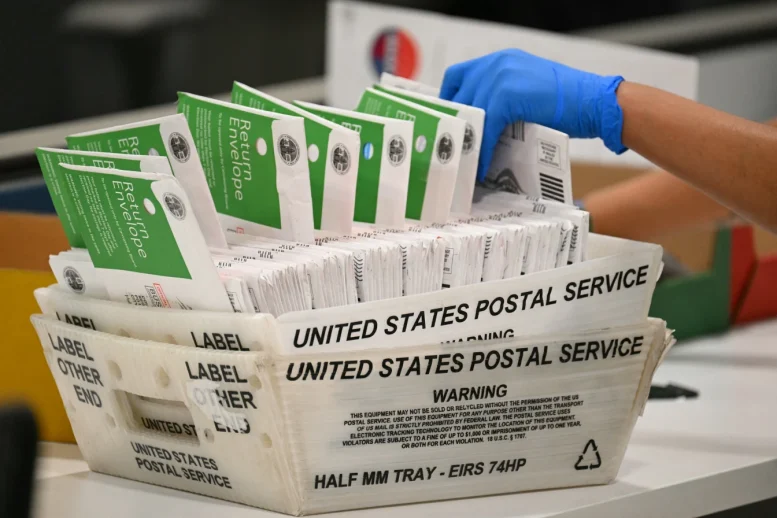
Featured Image: An election worker processes mail-in ballots in the city of Industry on June 2. (Patrick T. Fallon / AFP via Getty Images)

Petition to reject Trump order forcing USPS to reject ballots

Steve HutkinsFeatured

Americans for Financial Freedom, a progressive nonprofit coalition of approximately 200 consumer, labor and special interest groups that advocate for financial reform, has launched a petition drive demanding that the USPS reject Trump’s illegal order to force the post office to disenfranchise millions of eligible voters. (The coalition uses “Save the Post Office,” but it is not affiliated with this website.)

Here’s the text of the petition:

Donald Trump is trying to turn the United States Postal Service into a federal checkpoint for mail-in ballots — and the USPS is getting ready to implement the illegal order in less than 30 days.

If this rule moves forward and is made final, millions of registered voters would not even receive their ballots to vote in federal elections, including for Congress or for President.

Let’s be crystal clear here: We’re not even talking about voters mailing their ballots back. We’re talking about the post office being told to not even send certain people their ballots to vote in the first place.

The proposed rule is based on Trump’s voter suppression executive order that attacks vote by mail. It would require state election officials to send USPS a list of voters based in part on Department of Homeland Security-created citizenship databases that have repeatedly been shown to be inaccurate and flawed.

Trump is trying to illegally declare the post office a federal election administrator to decide whether to mail certain eligible voters their ballots under the false flag of election security.

Voting by mail is safe, secure, convenient, and for many people, it is the only accessible way to cast a ballot. Seniors, voters with disabilities, rural voters, Indigenous communities, military families, students, caregivers, and working people all rely on the mail to exercise their right to vote.

The USPS delivers the mail. It does not run elections. It serves every address in the country, regardless of party, race, income, geography, disability, age, or citizenship status. Its mandate is to provide universal service to the public, not carry out Trump’s voter suppression agenda.

We have fought attacks on vote by mail before, and when the public speaks up and fights back, we’ve won. The USPS is required to hear public comments on this plan before they can implement it. It’s time to fight back and win — again.

The Postal Service’s job is to deliver ballots, not help Trump decide who gets one. The USPS must reject this unlawful order, protect universal service, and refuse to let the mail become a weapon against eligible voters.

Click “START WRITING” to submit an official comment against this plan to demand the USPS protect vote by mail and reject implementation of Trump’s illegal order now.

Confirmation hearings on nominees to USPS Board of Governors begin this week

Steve HutkinsBlog, Featured

UPDATE: The hearing held on June 17 did not include all four of the nominees. Brodsky and Gallo were part of a panel with nominees for other positions, and they were asked only a few, cursory questions. A Senate aide for the Democrats told Federal News Network that Lomangino and Steffens had not yet completed the committee’s required ethics paperwork. Ranking Member Gary Peters raised concerns about an “overcrowded lineup” of nominees for various positions and said the confirmation process has been “unnecessarily rushed.” (All this is fairly odd, given that Lomangino was originally nominated in May 2025, and Steffens was nominated in March 2026.) The hearing video is here.

On June 17, the Senate Homeland Security and Governmental Affairs Committee is scheduled to begin confirmation hearings for President Trump’s four nominees to the Postal Service Board of Governors. 

The Senate Homeland Security and Governmental Affairs Committee, chaired by Sen. Rand Paul, R-Ky., will oversee the vetting process. 

The Postal Reorganization Act (PRA) mandates that the board maintain a political balance, stipulating that no more than five of the nine presidentially-appointed governors can belong to the same political party.

To ensure this balance, the PRC requires that congressional leaders in both parties are consulted about nominations. The Trump administration may have bypassed this bipartisan process, and it has advanced what appears to be an all-Republican lineup. No Democrat was included.

If all four of these nominees are confirmed, the board will have five Republicans and two Democrats, plus one independent, with one seat unfilled. With five Republicans, the board will not be in technical violation of the PRA, but the balance of power will have shifted significantly. 

One of the goals of the PRA (39 U.S.C. § 202) was to ensure that by replacing the Post Office Department with the Postal Service, the new, quasi-independent agency would act more “like a business” — a step toward ultimately privatizing it.  The Postal Service would be governed by a corporate-type board consisting of those with “experience in the field of public service, law or accounting” or with a “demonstrated ability in managing organizations or corporations (in either the public or private sector) of substantial size.” At least four of the Governors were to be chosen because they had managed organizations or companies with at least 50,000 employees.

None of the current board members or nominees has managed companies anywhere near that large, but the nominees appear to fulfill the other criteria. Apparently it also helps if you’re based in South Florida.

Here’s an overview of the nominees:

Anthony Lomangino was initially nominated in 2025, but the Senate failed to act on his nomination before the session ended. The Trump administration resubmitted his name in January, and it’s finally being considered by the Senate to replace Roman Martinez IV, for a term expiring December 8, 2031. 

As profiled by Waste Today Magazine, Lomangino founded and managed several prominent sanitation firms, including Southern Waste Systems (which had 750 employees). He is a prominent Republican donor who co-founded Right for America, a single-candidate super PAC in support of Trump. According to Open Secrets, in 2023-2024, Lomangino and Southern Waste Systems donated approximately $8.9 million to the Trump campaign.

The APWU has raised conflict-of-interest concerns regarding Lomangino because two of his former sanitation companies were acquired by Waste Management Inc., including one while David Steiner, the Postmaster General, was the Waste Management CEO. 

In February 2026, Lomangino purchased a historic Palm Beach mansion for $76.73 million. It’s located at 260 North Ocean Boulevard, about 3.6 miles from the Mar-a-Lago Club. 

Jeffrey Brodsky: A financial management consultant, Brodsky co-founded Quest Turnaround Advisors (50 employees). According to his corporate bio, his career centers on corporate restructurings and debt crises, having managed the bankruptcy operations of major firms like Adelphia Communications Corporation and Residential Capital. Quest has offices in Rye Brook, NY, and Palm Beach, Florida, at 2000 South Ocean Boulevard, about 2.4 miles from Mar-a-Lago. 

William Gallo: An entrepreneur and retired commodities broker, Gallo maintains investment positions in real estate, healthcare supplies, and the entertainment sector. His proposed term would replace former Democratic governor Anton Hajjar. Gallo is formerly the President and CEO of Pasternak, Baum & Co., one of the largest international grain brokerage firms in the world (50 employees). He currently manages diverse personal investments, including horse breeding. He is the owner of GalloStables, located in Hallandale Beach, Florida, where he also resides, an hour south of Mar-a-Lago.

Robert Steffens: Nominated to replace Robert Duncan, for a term running through December 8, 2032, Steffens is a Texas-based finance executive. According to leadership appointments tracked by the Sports Video Group, he recently served as the CFO for the sports streaming platform FloSports (760 employees). He also spent more than two decades in financial oversight and operational roles at Marvel Entertainment (1,500 employees), where he served as co-president and CFO. As noted by Government Executive, in 2025 Steffens sued the company’s parent, Disney, alleging that he was told secondhand that he had been passed over for a promotion because he is “another old white guy.” 

The four current governors are Independent and Board Chair Amber McReynolds; Democrats Ron Stroman and Dan Tangherlini; and Republican and Vice Chair Derek Kan

A Board of Governors heavily tilted like this one is shaping up to be may be inclined to implement aggressive cost-cutting measures, including service reductions and post office closures — a step already being floated by the Postmaster General.

Such a board might also be willing to accommodate Trump’s efforts to turn the Postal Service into a tool that will advance his election reform agenda. 

The Postal Service recently proposed a controversial rule change that would require the agency to refuse the delivery of mail-in ballots in states that decline to share their voter rolls with federal authorities. Trump’s board could push this rule change as well as similar changes in line with the conservative agenda.

Here’s a list of the current board members and nominees from Wikipedia.

PositionNamePartyAssumed officeTerm expirationAppointed byNotes
CURRENT MEMBERS
ChairAmber McReynoldsIndependentJune 15, 2021December 8, 2026Joe BidenReplaced David C. Williams
Vice ChairDerek KanRepublicanMay 20, 2022December 8, 2028Joe BidenReplaced John McLeod Barger
GovernorRon StromanDemocraticJune 15, 2021December 8, 2028Joe BidenReplaced Ellen Williams
GovernorDan TangherliniDemocraticMay 20, 2022December 8, 2027Joe BidenReplaced Ron Bloom
NOMINEES
GovernorJeffrey BrodskyRepublicanDecember 8, 2029Donald TrumpReplacing William D. Zollars
GovernorWilliam GalloRepublicanDecember 8, 2030Donald TrumpReplacing Anton Hajjar
GovernorAnthony LomanginoRepublicanDecember 8, 2031Donald TrumpReplacing Roman Martinez IV
GovernorRobert SteffensRepublicanDecember 8, 2032Donald TrumpReplacing Mike Duncan
GovernorVacantDecember 8, 2029Replacing Donald L. Moak
EX OFFICIO
Postmaster GeneralDavid P. SteinerJuly 15, 2025No term limitThe Board
Deputy Postmaster GeneralDouglas TulinoIndependentMay 12, 2021No term limitThe BoardReplaced vacancy left by Ron Stroman.

PRC petitioned to review USPS proposal to change mail voting

Steve HutkinsBlog, Featured

A petition filed Thursday with the Postal Regulatory Commission argues that the Postal Service cannot implement its proposed election-mail regulations without first obtaining a formal advisory opinion from the commission.

The petition was filed by Sai, a native U.S. citizen currently living in the U.K., who is the president of Fiat Fiendum, a nonprofit public charity organization that focuses on civil rights, social advocacy, voter education, campaign finance, and government transparency. Recently Sai has been challenging the Postal Service’s treatment of mailing to the blind in a complaint and extensive filings with the PRC (C2024-13).

Sai’s filing yesterday argues that the PRC is required to formally review the Postal Service’s proposed ballot-mail rule before it can take effect. The petition also asks the PRC to add Election Mail to the Mail Classification Schedule as its own class of Market Dominant Mail. 

The Postal Service’s proposed rule change responded to a presidential executive order concerning federal elections. Among other things, the change in regulations would give the Postal Service an active role in determining which ballots may be carried through the postal system. (There’s more in this previous post and today’s New York Times.)

Sai’s petition argues that the Postal Service’s proposed changes should be reviewed by the PRC under the statute governing advisory opinions, 39 U.S.C. § 3661(b), which states:

“When the Postal Service determines that there should be a change in the nature of postal services which will generally affect service on a nationwide or substantially nationwide basis, it shall submit a proposal, within a reasonable time prior to the effective date of such proposal, to the Postal Regulatory Commission requesting an advisory opinion on the change.”

In the past, Section 3661 has been applied to proposed changes like eliminating Saturday delivery, mass closures of post offices, reducing operating hours at post offices (POStPlan), and revising service standards on delivery times. Most recently, the PRC conducted an advisory opinion on aspects of the Delivering for America plan that affect services, including eliminating evening collections at post offices (RTO). 

Sai’s petition argues that the proposed ballot-mail rule clearly qualifies as a change in the nature of postal services on a nationwide basis and the Postal Service therefore cannot lawfully proceed without Commission review. 

Under the statute, the Postal Service is supposed to request an advisory opinion before implementing such changes. The petition argues that the Postal Service is attempting to evade the required regulatory review by not requesting an advisory opinion.

The petition argues that if the Postal Service doesn’t request an opinion, the PRC should initiate such a review itself. As the petition states, the PRC “cannot abandon its statutorily obligated oversight duty and let the Postal Service choose when it does or doesn’t want oversight of its proposals to change the nature of service — let alone when it knows it is being circumvented.”

The Commission has never initiated an advisory opinion without a request from the Postal Service, but it has opened what’s called a Public Inquiry docket. That’s what happened when the Postal Service was dragging its feet on requesting an opinion on Delivering for America. Perhaps the Commission will do the same in this case as well.

While the Postal Service can claim to be exempt from the Administrative Procedure Act, the PRC cannot, claims the petition. The Postal Accountability and Enhancement Act (PAEA) (enacted in 2006) subjects the PRC’s actions — such as rulemakings for rate approvals — to the procedural requirements and judicial review standards of the APA. Under the APA, argues Sai, the PRC itself would need to conduct a proceeding on the proposed changes.

The petition therefore asks the Commission to open a formal Section 3661 proceeding by July 1, 2026 (when the public comment period on the Federal Register notice ends).

The petition also asks the PRC to require the Postal Service to disclose all public comments it receives regarding the Federal Register notice. Normally an agency summarizes the comments without publishing them, which places them, as Sai puts it, in a “black hole.” 

The petition also focuses briefly on military and overseas ballots governed by the Uniformed and Overseas Citizens Absentee Voting Act (UOCAVA). The Postal Service says that its proposed rule does not currently apply to UOCAVA ballots, but the Federal Register notice invited public comments on those issues, which leaves open the possibility of future changes affecting military and overseas voters without adequate notice.

The petition therefore asks the Commission to require the Postal Service either to formally disclaim any intention of changing UOCAVA ballot treatment without further approval or to acknowledge that future changes remain possible.

The second major request in the petition seeks formal recognition of Election Mail as a distinct product category within the Mail Classification Schedule.

Election Mail is currently treated as something like a service enhancement rather than as an independent postal product category. So, for example, in the days preceding a national election, the Postal Service implements what it calls “extraordinary measures” to ensure ballots are delivered to election centers before the deadline.

Sai’s petition argues that the Postal Service should make Election Mail a separate category of Market Dominant Mail in the Classification Schedule, along with First Class, Marketing, Periodicals and Special Services (Certified, Registered, Insured, etc.). Such a classification change would allow the Postal Service to give special consideration to Election Mail. This could include expedited service, free postage, and guaranteed postmarks on the day the ballot is mailed (which would address the problems caused by the Regional Transportation Optimization initiative, discussed here). 

The new classification would include ballots sent to and from voters, voter registration materials, absentee-ballot applications, polling-place notifications, official election information mailed by election officials, military and overseas voting materials. It would not include partisan campaign advertising, which the Postal Service calls “political mail” as opposed to “election mail.”

To support both proceedings, the petition asks the PRC to require extensive disclosure of Postal Service records. This would include internal policies, training materials, operational plans, election-mail performance data, postmarking procedures, election-mail studies, and documents related to the proposed rule. 

The filing says that placing Election Mail in the Mail Classification Schedule would make election-mail requirements transparent and enforceable, prevent the Postal Service from changing election-mail practices without PRC approval, provide a clearer regulatory framework for election officials and voters, and reduce future litigation by establishing stable, publicly known standards. 

Extensive litigation on the proposed changes to election mail is already underway. The president’s executive order is being challenged in federal court by the League of Women Voters of Massachusetts, the ACLU of Massachusetts, the Brennan Center for Justice and other organizations. 

The Postal Service’s proposed rule is also being challenged in federal court by the NAACP, the Legal Defense Fund (LDF) and Public Citizen Litigation Group.

Sai has extensive experience in filings with the PRC. The docket on mailing to the blind has been going on since June 2024, and Sai has filed sixty motions, notices, and comments. Yesterday’s filing with the PRC will probably not be the last of it on this issue. 

Perhaps the PRC will initiate a public inquiry docket, or perhaps it will simply post a preliminary notice inviting comments on whether such an inquiry is necessary. The Postal Service will file a motion objecting, arguing that an inquiry is premature or outside of the Commission’s authority (as it is wont to do). Sai and perhaps others will file responses, and the Commission will issue rulings on the objections and responses. Stay tuned for more if and when the PRC opens a docket.

— Steve Hutkins

NY Election Officials Urge Voters to Mail Ballots Early Following USPS Postmark Changes

Steve HutkinsBlog, Featured, News

Press Release: ALBANY, N.Y. (06/09/2026) – New York State State Board of Election officials are encouraging voters to return early mail and absentee ballots for the June 2026 Primary Election as soon as possible following recent changes to U.S. Postal Service (USPS) postmark procedures that may affect how mail is dated and processed.

Under updated USPS guidance this year, a postmark reflects the date a mail piece is processed at a postal facility rather than the date it was deposited in the mail. As a result, mail placed in a mailbox on a particular day may not receive a postmark until a later date. To ensure ballots are counted, voters are strongly encouraged to mail their ballots well before the deadline or return ballots directly to a poll site or their county board of elections.

“While these postal changes do not alter New York’s election laws, they underscore the importance of voters making a plan to return their ballot,” stated Kristen Zebrowski Stavisky, Co-Executive Director of the State Board of Elections. “The most effective step voters can take is to return their ballot early. Doing so helps ensure their vote reaches election officials in a timely manner and eliminates uncertainty related to mail processing.”

“The Board is committed to ensuring voters understand how these changes may affect the handling of mailed ballots,” added Raymond J. Riley III, Co-Executive Director of the State Board of Elections. “We encourage every voter who plans to vote by mail to review the deadlines, understand their options, and return their ballot as soon as possible.

Every eligible voter should cast their ballot with confidence in the process and peace of mind.”

New York State election law permits ballots to be postmarked up through election day. Voters who choose to mail a ballot close to this deadline may request a manual or hand-stamped postmark at a USPS retail counter. These are available at no charge upon request. Properly postmarked ballots must be received by the voter’s county board of elections within seven days of election day.

Voters in New York are encouraged to contact the State Board of Elections or their local county boards of elections directly for information about the upcoming election and voting options. If you have any questions regarding this press release, please contact Kathleen McGrath or Jennifer Wilson at the State Board of Elections at (518) 474-1953 or by email at INFO@elections.ny.gov.

IMPORTANT DATES TO REMEMBER:

The 2026 Primary Election is June 23, 2026.

For new voters, the deadline to register to vote before this election is June 13, 2026.

For voters wishing to receive a ballot by mail, the deadline to make this request is June 13, 2026. Early in-person voting occurs from June 13, 2026, through June 21, 2026.


The Postal Service gets in deep on proposed changes to mail voting

Steve HutkinsBlog, Featured, News

The Postal Service is once again being embroiled in the national debate over voting by mail.

In March the President issued an executive order on mail voting that represents an unprecedented federal intervention into the election system, with the Postal Service playing a key role.

Earlier this week the Postal Service published a proposed rule in the Federal Register intended to implement the changes mandated by the executive order.

Under the order, states would be required to provide voter and ballot data to the Postal Service, and the agency would assume an active role in determining which ballots may be carried through the postal system.

The proposed rule will be subject to a 30-day public comment period before it can be finalized. It’s not clear at this point if the executive order and the Postal Service’s proposed changes will be implemented before the November election, but that’s a distinct possibility. It would cause innumerable problems.

Earlier controversies

This is not the first time the Postal Service has found itself at the center of an election controversy.

In the summer of 2020, just months before the election, Postmaster General DeJoy, a major Trump contributor, made operational changes that caused a steep decline in delivery times. Multiple lawsuits argued that the moves were politically motivated to suppress the mail vote, and postal officials had to testify in court to justify the changes.

Earlier this year, the Postal Service issued a rule in the Federal Register alerting the public about its postmarking policies and procedures. Under a new initiative called Regional Transportation Optimization (RTO), mail is no longer collected at the end of the day at three-fourths of the nation’s post offices.

Postmarks are thus applied the day after the mail is sent. For states that have a grace period during which ballots are accepted if they’re postmarked by Election Day, this means many more ballots will be disqualified. States are already seeing a spike in ballot rejections, as discussed in this previous post.

The postmark issue could become irrelevant, however. A case currently before the Supreme Court,  Watson v. Republican National Committee, involves a challenge to the practice of accepting ballots after Election Day. If the Court rules that the grace period is unconstitutional, as it seemed inclined to do during oral arguments, all mail ballots in national elections would need to be received at election centers by Election Day. Delays caused by the RTO may still cause more ballot rejections, however, which may be behind the spike in late ballots last week in the Wisconsin election.

What the Executive Order Requires

Under Trump’s March 31 executive order, “Ensuring Citizenship Verification and Integrity in Federal Elections,” federal agencies will create lists of individuals deemed eligible to vote in federal elections. States that wish to use mail voting would need to coordinate with the Postal Service and provide information about voters receiving mail ballots.

The lists would include voter information and unique ballot identifiers. States would also be required to use unique barcodes on both outbound ballot envelopes and return envelopes.

While seemingly technical in nature, these changes represent a major transformation of the role of the Postal Service in elections.

Historically, election officials have determined voter eligibility, maintained voter rolls, mailed ballots, and counted votes. The Postal Service functioned primarily as a neutral delivery service. Under the proposed framework, the Postal Service would become an active participant in determining whether ballot mail meets federal requirements.

The proposal is likely to trigger extensive litigation, with several lawsuits already pending that challenge the executive order. Legal experts expect additional lawsuits to focus specifically on the Postal Service implementation efforts, creating significant legal uncertainty.

Problems and Risks

The proposed rule has drawn extensive criticism from legal scholars, postal policy experts, election administrators, and lawmakers.

The Brennan Center for Justice and other groups are challenging the executive order in court on constitutional grounds. State election officials, such as Washington Secretary of State Steve Hobbs, argue the proposed changes are unnecessary and do nothing to provide security in elections.

Senator Alex Padilla of California, as well as other legal experts, have also raised concerns about the independence of the Postal Service and the risk of extensive litigation.

Postal policy expert Kevin Kosar has listed numerous concerns about the technical complexity, governance, and legal authority of the USPS involvement.

Here’s a summary of the main concerns and criticisms.

Constitutional and Legal Authority Challenges: The Constitution assigns primary responsibility for election administration to the states, subject to Congress. The Brennan Center argues the executive order attempts to put federal agencies, including the Postal Service, in charge of determining who may vote by mail, a role reserved for states under existing law. Furthermore, as Kosar notes, it’s not clear whether postal law actually authorizes the Postal Service to act as an enforcement mechanism for election law and citizenship verification.

The Postal Service Governance and Independence Question: The Postal Service has statutory independence, and oversight is by the Board of Governors, not the executive branch. As Senator Padilla has stated, the Postal Service is intended to operate as an independent agency and should not be directed to implement partisan election policies.

Risk of Eligible Voters Being Excluded: One of the most frequently cited concerns is that eligible voters could be omitted from federal voter lists due to errors, outdated information, or incomplete federal databases. The federal data sources that will be used to verify voter eligibility were not designed for election administration and may contain inaccuracies or gaps.

Ballot Delays: Introducing new verification procedures could slow down critical ballot distribution and return processing. Since mail voting relies on precise timelines, any delays caused by data mismatches, technological failures, or administrative errors could prevent ballots from reaching voters or being counted before deadlines.

Privacy and Data Security Concerns: Centralizing voter information, which includes requiring states to share data about voters receiving mail ballots, raises questions about privacy, data security, and the potential misuse of election-related information.

Administrative and Financial Burdens on States: State election officials warn that compliance could require costly changes to their existing administration systems. States would need to create new procedures for transmitting voter data to the Postal Service, resolving discrepancies, and managing barcode systems, imposing significant additional administrative burdens and costs on local offices. Implementing a massive, nationwide system overhaul only months before a federal election would be plagued by operational complications.

Interference with Existing Successful State Systems: Officials in states that rely heavily on mail voting (such as Washington, Oregon, Colorado, Utah, and Hawaii) have expressed concerns that the proposal could interfere with systems that have operated successfully for years, challenging state authority without providing meaningful security benefits.

Need for Congressional oversight: Kosar argues Congress should hold public hearings to provide transparency and scrutiny regarding how this complicated inter-agency system would actually work before proceeding with dramatic changes.

What Happens Next

The proposed rule was published in the Federal Register on June 4. The public has 30 days to submit comments. The Postal Service will review those comments and possibly implement revisions before issuing a final rule. State election officials, advocacy groups, political organizations, and members of the public are expected to participate heavily in the process.

At the same time, litigation over the executive order continues. Several courts are considering challenges to the administration’s efforts to reshape election procedures, and future rulings could significantly affect whether the Postal Service’s proposal ultimately takes effect.

Whatever happens, this is clearly a headache the Postal Service doesn’t need.

— Steve Hutkins (assisted by Gemini AI)

(Featured Image: Nati Harnik/AP)


CPWU Summer 2026 Newsletter

Steve HutkinsBlog, Featured, News

The Summer 2026 Newsletter from Communities and Postal Workers United has articles about a nationwide rally for “Next Generation Carriers”; a joint letter to Congress from the four postal unions; an OIG report on expanding access to government services through the postal network; a call to subsidize rural postal service. Read the newsletter.

How RTO shifts costs from the USPS to Us

Steve HutkinsBlog, Featured

Over the coming months, the Postal Service will complete implementation of its Regional Transportation Optimization (RTO) initiative. The cost savings remain unclear, but the impacts on the country are coming into focus. It’s not a pretty picture.

Under the RTO, mail and packages are no longer  collected at post offices at the end of the business day for dispatch to a processing center. Instead, everything is held overnight in the back of the post office and picked up the following morning when the day’s mail is dropped off.

According to USPS filings before the Postal Regulatory Commission, the Postal Service estimates that eliminating the evening collection and combining two trips into one will reduce highway transportation mileage, burn less fuel, and curb underutilized truck capacity. The Postal Service says the annual cost savings for RTO will eventually be approximately $650 million.

It’s not clear, however, how much the RTO is actually saving. In its annual compliance determination report, the PRC expressed concern over the lack of cost-savings tracking for the RTO initiative (as also noted in an OIG Report).

The PRC found that the Postal Service’s estimates for all the network changes under review (not just RTO) “were untethered to historical performance, scenario testing, or sensitivity analysis.” The Commission could not confirm the Postal Service’s projected cost savings.

The RTO began with a pilot in late 2023. It’s now been implemented at about 15,000 post offices — about two-thirds of the overall plan — and the Postal Service has yet to offer a full accounting of the savings.

Whatever the cost savings may be, they do not exist in a vacuum. Individual mailers, businesses, and government agencies incur many additional costs due to the slower RTO mail. And however they’re calculated, these costs far exceed what the Postal Service may save.

The scope of the impacts

The RTO applies to post offices more than 50 miles from one of the network’s 56 Regional Processing & Distribution Centers (RPDCs). Those within this radius continue to get the end-of-day collection. They too are impacted, however, because anything they’re receiving from an RTO post office will arrive a day or more later. This means that the entire country is suffering the slowdown of RTO, not just those served by RTO post offices.

When RTO is fully implemented across the nation, approximately 23,000 post offices — three-fourths of the 31,000 USPS-operated post offices in the country — will no longer receive an end-of-day collection.

About 157 million people — nearly half of the country — live in areas served by RTO post offices. About 77 million residential delivery points out of 153 million, and 6 million business delivery points out of 12.3 million, are located in RTO areas.

It’s worth noting, by the way, that while the RTO obviously slows down the mail, it’s not considered “delayed.” That’s because the Postal Service revised its service standards in 2022 to reflect the extra day in transit. The mail may be slower, but it’s officially “on time.”

Impacts on transportation providers

The most immediate impacts of RTO have fallen on the private companies and their drivers who transport mail between processing centers and post offices.

The postal system’s use of contract transportation goes back to the Star Routes of the stage-coach era. In 2021, about 1,500 suppliers of Local Distribution Transportation (LTD) covered routes less than 300 miles, which includes virtually all of the routes between post offices and processing centers.

Eliminating the evening collection at post offices eliminates millions of work hours for these contract providers, the equivalent of several thousand jobs.

Companies that have provided transportation to the Postal Service for decades have seen their routes disappear. Many have had to downsize and lay off employees. Some have gone out of business.

Job losses like these are a visible impact of the RTO, but there are many invisible impacts on the rest of the economy. Let us count the ways.

1. Mail Float

When an individual or a business mails a check to pay a bill, that capital enters a state of financial limbo known as “mail float.”

Every day that these checks are in the mail system costs the recipient money in terms of lost interest and related expenses. The phenomenon operates as an invisible “float tax” levied on American enterprises.

Quantifying the scale of the float tax is difficult, but one can make a back-of-the-envelope estimate.

Source: Deluxe Report

According to the most recent USPS Household Mail Survey, American households paid 14 percent of their bills by mail. The 2023 study (the Postal Service stopped sharing annual data the following year) reported that households sent 1.75 bill payments and 236 million donations through the mail. That’s roughly 2 billion payments sent by households. They also received 778 million payments from businesses. (The volume of business-to-business payments sent in the mail is not reported in the Household Diary Study.)

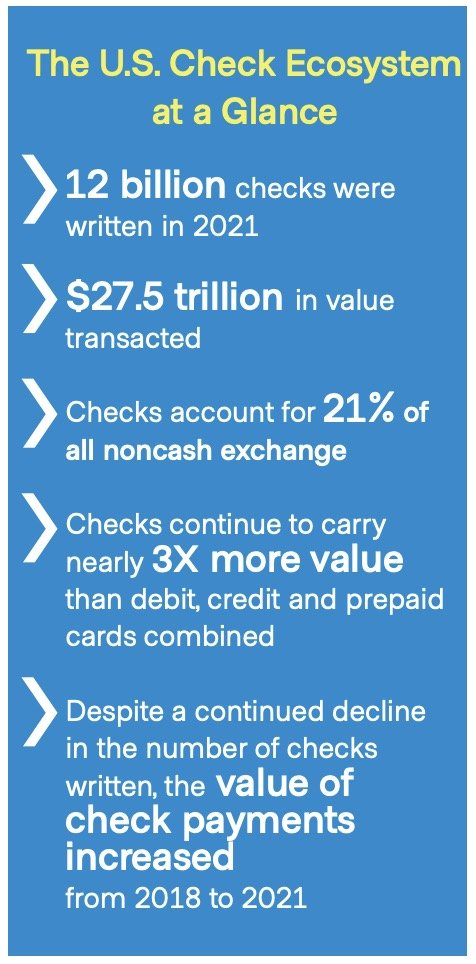
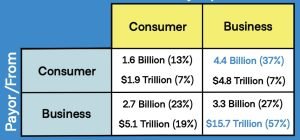
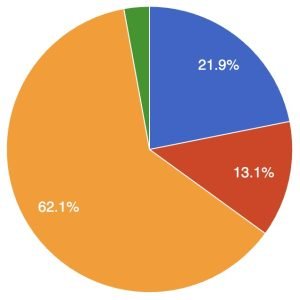
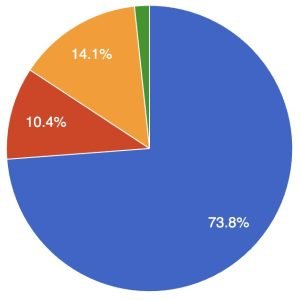
According to a Deluxe report on “The Check’s Enduring Role in the Payments Ecosystem,” based on the Federal Reserve’s Triennial Payments Study for 2018-2021, the total number of checks written in 2021 was 12 billion, with an average value of $2,400. This chart shows the breakdown.

Source: Deluxe Report

Consumer checks include consumer-to-consumer (C2C), sometimes referred to as person-to-person (P2P), and consumer-to-business (C2B). The vast majority of consumer checks are for relatively small amounts (under $300), but large C2B payments for rent, mortgages, tuition, down payments, etc., drive up the average. Overall, consumer checks averaged about $1,000.

Business-to-consumer (B2C) checks — mostly paychecks — averaged about $1,900. Business-to-business (B2B) payments averaged about $4,700.

Here’s a table showing a hypothetical scenario of checks in the mail based on the Federal Reserve numbers, the Household Diary Study, and a little guesswork.

CheckTotal Volume (billions)Average AmountVolume sent via USPSUSPS Volume (billions)USPS Total ($ billions)
C2C + C2B6$1,01033%1.98$2,000
B2C2.7$1,88928%0.76$1,428
B2B3.3$4,75828%0.92$4,396
Total12$2,48030%3.66$9,077

This scenario indicates that something on the order of $9 trillion may be passing through the Postal Service each year.

That estimate may seem too astronomical to be believed, but a USPS report in 2009 stated that “the total value of transactions moving through the mail each year is $30 trillion.” This may include bills and charitable requests as well as payments, rebates, and donations, and of course, many of those transactions have shifted to electronic payments since 2009 — First Class mail volume has fallen by half since then.

But the estimate may not be too far off the mark. The Federal Reserve report shows 12 billion checks totaling $27 trillion in value in 2021. If a third of these checks were sent through the mail, as suggested by the scenario, it’s possible they valued $9 trillion. As for 2025, it’s possible that the trend of 2018 to 2021 — a decline in the number of checks but an increase in their average value —  has continued over the past four years.

About half the country’s population and half its business addresses are served by RTO post offices, so let’s assume that half of the $9 trillion and half of the 3.7 billion checks originate in RTO post offices.

To calculate the lost interest due to  the mail float, the equation is as follows:

Float Value = Mail Volume × Average Payment × Delay Time × Interest Rate.

For our scenario, for a volume of 1.83 billion checks, an average amount of $2,400, a delay time of 1 day (out of 365), and a conservative interest rate of 5 percent, the lost interest comes to about $620 million annually (one day’s interest on $4.5 trillion). That’s just about what the Postal Service says it will save from the RTO.

When it presented the RTO to the PRC for an Advisory Opinion, the Postal Service said it had not done a study of potential impacts on remittance mail, and it provided no estimate for the amount of money that might be delayed. The Postal Service estimated that overall about 40 percent of single-piece First Class mail would slow down.

That’s somewhat less than the 50 percent used in our calculation, but the Postal Service’s estimate does not include another RTO-related change. The Postal Service also decided to exclude Sundays and holidays as transit days for volume entered into the network on Saturdays or the day before a holiday. The PRC determined that this change can add a day or more to delivery times and expands a portion of single-piece mail from 5 to 6 days or more. Every additional day increases the float tax on individuals and businesses waiting for a check in the mail.

2. Opportunity costs

Beyond the direct float tax lies a deeper economic drag caused by the RTO: opportunity costs. Cash sitting overnight in the post office is dead capital; it cannot be reinvested to drive growth, fund research, or maintain day-to-day operations. RTO taps the brakes on the economy.

The opportunity-cost analysis considers what else could the delayed money have been doing, like R&D, expanding a business, etc., and what extra costs are incurred due to the delay, like additional borrowing, deferred purchases, reduced payroll flexibility, and so on.

Opportunity costs are even more difficult to estimate than the float tax, but they are often several times greater. Let’s be conservative and say the impacts of RTO are twice the lost interest. That would come to $1.25 billion a year.

There are other hidden costs associated with the RTO. They are almost impossible to calculate, but they are very real.

3. Impacts on E-commerce

E-commerce giants like Amazon provide speedy delivery by entering their shipments into the postal system at processing centers or post offices, so they are not directly affected by the RTO.

Independent online retailers and small businesses, on the other hand, typically ship from the post office, and if it’s an RTO office, the shipment starts off a day late.

The Postal Service treats data on Competitive products like parcels as confidential, so its filings to the PRC on RTO are non-public. But companies like eBay, Etsy, and Poshmark are among the Postal Service’s biggest customers for shipping, and together they may account for as much as 500 million shipments a year, perhaps more. Half of them may originate at an RTO post office.

The financial fallout for online retailers is multi-faceted: If consumers notice that a product shipped via USPS will take longer to arrive, they may migrate to larger platforms like Amazon. Slower transit times also lead to an increase in customer complaints and low feedback scores, which hurt a seller’s future revenues.

By degrading the delivery times for parcel shipping at three-quarters of the nation’s post offices, the Postal Service penalizes the small businesses that rely on it the most.

4. Impacts on Marketing Mail

Marketing mail represents more than half of USPS volumes. These mailings are sent pre-sorted, and they are therefore excluded from the RTO, which applies only to single-piece mail. It might seem, then, that marketing mailers do not suffer the impacts of RTO. But that’s not the case.

The economic viability of direct mail campaigns depends on rapid responses to marketing campaigns via business reply mail or prepaid envelopes. In 2022, the Postal Service processed over 310 million pieces of business reply mail. Half of such replies may come from RTO offices.

Slower responses can damage a campaign’s return on investment in various ways. For example, delays stretch the sales cycle, slowing the cash flow and postponing revenue generation. Slower processing of response cards also allows time for buyer’s remorse or for competition to steal the sale, which depresses conversion momentum.

Ultimately, when marketing campaigns falter due to slower mail, businesses may shift budgets to costlier digital platforms.

5. Shifting to expedited services

The slower delivery times caused by RTO may incentivizes some individuals and businesses to upgrade a mailing from First Class to expedited services like USPS Priority and Express (both of which may also leave the post office a day later under RTO) or to services provided by private carriers like FedEx, UPS, and local couriers.

These alternatives are always more expensive than First Class Mail. For businesses, that means more operational costs, which are ultimately passed down to consumers.

6. Public sector costs

State and local governments rely heavily on the Postal Service for sending property tax assessments, vehicle registration renewals, jury duty summonses, and election ballots. When RTO slows down this civic mail stream, it disrupts government administration and leads to more public expenditures.

The RTO is already having an impact on postal voting. Election officials now need to spend time and money alerting voters to the fact that their mail ballots may not be postmarked on the day sent — the deadline in fourteen states — and may take longer to arrive at election centers. Some states are investing in tracking software to ensure statutory deadlines are met, driving up municipal expenditures.

To ensure their ballot arrives on time, voters may need to spend more time at the post office waiting for a hand-stamp cancellation, or they may pay more for certified mail and expedited shipping.

As discussed in this previous post on how RTO is affecting elections in Washington state, the fact that postmarks may be applied the day after a ballot is sent means that more ballots are being rejected as invalid.

When a ballot is rejected, all the expense of printing, sending and receiving the ballot is wasted, to say nothing of the harm done by disenfranchising a voter.

7. Regulatory and legal penalties

Many financial and legal documents carry strict statutory deadlines. For instance, mortgage payments, utility bills, credit card balances, and tax filings must be received by specific dates to avoid penalties.

When RTO slows down the mail stream and causes postmarks to be applied the day after mailing, consumers often face undeserved late fees, interest penalties, and damage to their personal credit scores. These costs act as a tax on household budgets and reduce consumer spending.

In the legal sphere, delivery adjustments of certified mail, court summonses, and legal notices can cause missed court dates, delayed settlements, and increased billable hours for corporate legal teams scrambling to remedy procedural issues caused by missing mail.

8. Healthcare expenses

When it presented the RTO for review by the PRC, a witness for the Postal Service testified that “the vast majority of pharmaceuticals volume will remain unaffected by the proposed changes.” That’s because medications sent by mail-order pharmacies and other large companies are entered pre-sorted at processing centers, so they’re not subject to the RTO.

Data about the RTO impacts on pharmaceuticals were submitted to the PRC as part of its review for an advisory opinion. But the data were deemed confidential and submitted in a non-public filing, so we don’t know how many medications are sent from RTO post offices.

Many retail outlets, including those in large chains like CVS, sometimes send medications directly to customers by giving them to letter carriers on their daily routes. Some retail pharmacies prefer local mailing because it keeps customers loyal, saves them a trip to the pharmacy, and reduces the need for more staffing. This localized delivery option became especially popular during the pandemic.

But once the carrier returns to an RTO post office with the prescriptions, they don’t go out to the processing center a few hours later. Instead, they sit in the back of the post office, waiting for collection the next morning.

A Brookings report on the impacts of RTO on mail-order pharmaceuticals found that changes in speed or reliability of the postal network are “a serious health care issue, not just an inconvenience to post office customers.”

When RTO slows down delivery of medications, it can lead to a variety of adverse outcomes, like missed doses, heightened hospitalization rates, and more healthcare costs.

Adding up the costs

Viewed strictly as a business, it makes sense for the Postal Service to cut costs with initiatives like RTO, but the Postal Service is not just a business. It’s a public infrastructure, and it doesn’t make any sense for a government entity to externalize its costs to the rest of the economy the way RTO does. Cost saving should not be cost shifting.

It’s hard to say how much all of these impacts are costing the country, but the total is probably several times what the Postal Service may be saving.

Looking at the big picture, the country would be better off if Congress said no to RTO and simply wrote a check to the Postal Service for $650 million. It would save us a lot of money.

— Steve Hutkins

(Featured image: Deluxe report on “The Check’s Enduring Role in the Payments Ecosystem)

Post office in Watertown MA will not reopen: Another permanent suspension?

Steve HutkinsBlog, Featured

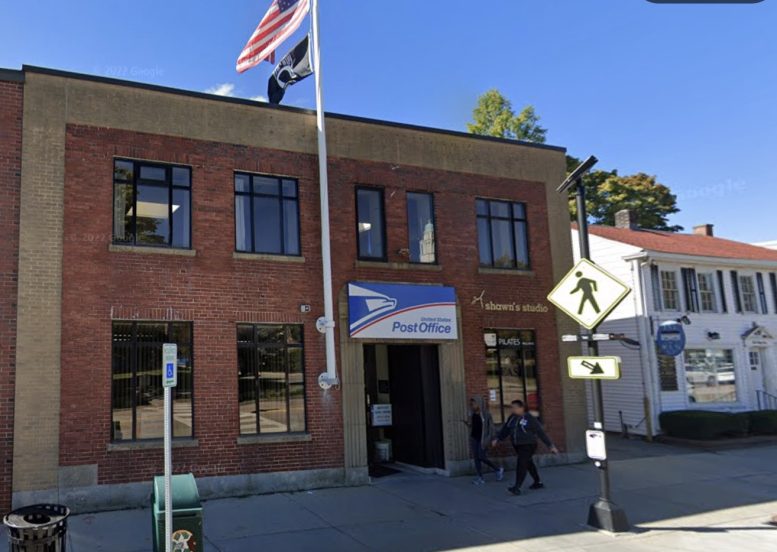
In January 2024, the Postal Service — on very short notice — suspended services at the post office on Main Street in Watertown Square, the downtown hub of Watertown (02472), on the west side of the Boston Metro area. The building’s owner planned to tear it down and replace it with a larger building.

At that time, a spokesperson for the Postal Service explained that “the landlord is planning to redevelop the property, a process that is expected to take approximately two years. We hope to move back into the newly renovated building at that time.”

Watertown Post Office was razed, Sept. 24, 2024. (Photo by Chuck Dickinson)
The Postal Service could have found temporary quarters or set up a temporary mobile unit, but instead it moved operations to the New Town office, about a half mile away.

The Watertown Square post office (officially Watertown Financial) is currently listed on the Find USPS Locations website as “Temporarily closed.” It’s been that way for nearly two and a half years.

Customers of the Watertown Square post office have had good reason to expect that when the new building was completed, the post office would reopen. 

Based on ongoing conversations with the Postal Service, the developer was optimistic that the post office would reopen later this summer when the building is ready for occupancy.

But the Postal Service recently informed the developer that it does not plan to open a branch in Watertown’s downtown.

Earlier this week, the City Manager told the City Council that the Postal Service had informed the developer that it no longer wishes “to explore adding locations as part of a wider strategy shift, despite the willingness and interest from the parties involved.” 

“My understanding,” said the City Manager, “is they canceled multiple in-progress conversations about opening retail storefronts far beyond just Watertown.”

That comment is noteworthy. Did the Postal Service reveal that there are no plans to ever open a replacement post office in Watertown, in the new building or anywhere else? Did the Postal Service actually tell the developer that it is no longer adding locations as part of a wider strategy?

Rendering of new building (Courtesy of O’Connor Capital Partners)

It’s possible that there’s been a misunderstanding or miscommunication.  Perhaps the Postal Service did not say it had no plans for a new downtown office at all. Perhaps when it came time to move back to the new building, the Postal Service decided that the lease costs were too high or there were other problems with the new space. But that doesn’t seem to have been communicated to the developer.

Congresswoman Katherine Clark and other elected officials have started advocating for a branch somewhere in Watertown Square, and it’s still possible a post office may eventually open in another downtown location.

But if the Postal Service has decided not to reopen a replacement branch, it is legally required to initiate a formal discontinuance process. The Postal Service cannot simply close a branch and consolidate its operations with another post office.

The discontinuance process involves a public comment period, a public meeting, and a right to appeal the closing to the Postal Regulatory Commission. The process is set forth in federal regulations and Handbook PO-101: Postal Service-Operated Retail Facilities Discontinuance Guide

As discussed in this previous post about the “permanent suspension” of a small post office in Wilton, Arkansas, it’s not uncommon for suspensions to go on for years without being resolved by a reopening or discontinuance. 

But suspensions cannot be permanent. De facto discontinuances are not legal, and they have been the subject of continuous review by the Postal Regulatory Commission, as well as criticisms and proposed legislation by members of Congress

It has often seemed that the Postal Service suspended a post office with no intention of ever reopening it, but it has never said as much. And even if it took years and much prodding by the PRC, the Postal Service has always gone through a discontinuance process before closing a post office permanently.

The Wilton and Watertown suspensions thus raise the question: Is the Postal Service now making suspensions permanent without ever going through a discontinuance process and giving the public an opportunity to comment and appeal? That would indeed be a new “wider strategy shift” for closing post offices.

There’s more about the problem of long-term suspensions in this post and on our suspension dashboard.

— Steve Hutkins

Expanding Access to Government Services Through the Postal Network

Steve HutkinsFeatured, News

USPS OIG: The U.S. Postal Service maintains an unrivaled presence in American life, utilizing more than 33,000 retail locations and a workforce of over 640,000 employees to reach every home and business six days a week. While USPS’s primary mission is mail and package delivery, it also manages a portfolio of nonpostal government services that generated $387 million in revenue during fiscal year (FY) 2025. However, this revenue stream is heavily dependent on passport services — with passport processing accounting for approximately 80 percent of total earnings — and all active partnerships remain exclusively at the federal level.

The landscape for providing government services shifted significantly with the Postal Service Reform Act of 2022, which gave USPS the authority to partner with state, local, and tribal governments for non-commercial public services. Despite this legal green light and the Postal Service’s Delivering for America plan’s goal of becoming a national “government storefront,” the organization has not yet established a formal strategy or initiated outreach to explore these new non-federal opportunities.

USPS OIG discussions with state and federal officials highlight the untapped potential of new government partnerships, particularly in rural and underserved areas where the post office often serves as a primary civic hub. Potential growth is evident in providing in-person identity verification for social benefit programs like SNAP or Medicaid, and in streamlining high-assurance biometric services, such as fingerprinting for state professional licensing. Facilities could also transform into digital access points by hosting DMV or IRS kiosks in “service deserts” where residents currently travel long distances for simple renewals or tax assistance. Additionally, USPS could lease rooftop space for 5G and broadband infrastructure to help bridge the digital divide in the thousands of underserved counties it already serves.

Future possibilities also include equipping the delivery fleet with sensors for passive data collection on air quality and road conditions, and leveraging the last-mile network to report infrastructure failures during national disasters. To turn these concepts into reality, the Postal Service could look toward international peers in Australia, France, and Italy, which have built successful government service portfolios through proactive sales teams and centralized management units. These operators thrive by standardizing their offerings to lower technical costs and using market intelligence to target areas where private competition is absent.

Currently, the Postal Service’s approach to government partnerships remains largely reactive and fragmented across multiple departments. To capitalize on its vast infrastructure and the interest expressed by state agencies, the OIG recommends postal leadership develop a unified strategic roadmap. This plan would outline the steps necessary to identify, evaluate, and prioritize expansion opportunities across all levels of government, finally moving the organization beyond case-by-case federal agreements toward its vision of a modern, multi-level government storefront.

Read the report.

Postal Service suspends post office in Wilton, Arkansas, “permanently”

Steve HutkinsBlog, Featured

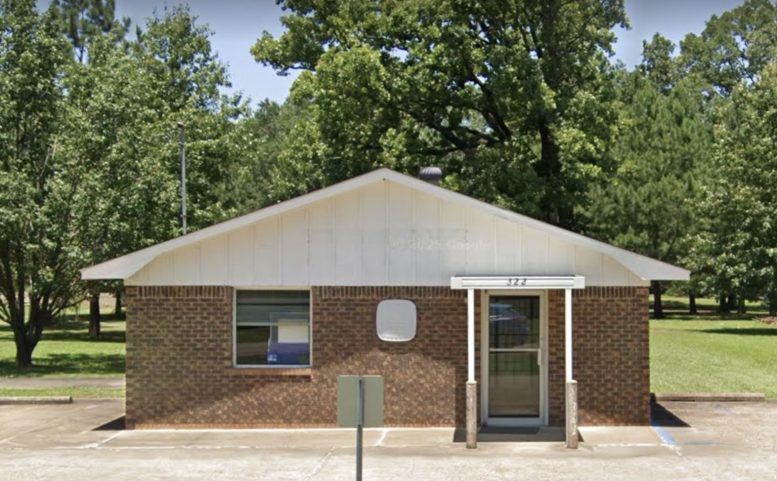
On April 10, 2026, the Postal Service issued an industry alert stating that operations at the post office in Wilton, Arkansas, were being suspended due to building issues. Operations have been moved to the post office in Ashdown, about 5.4 miles away.

Suspension notices are not uncommon, but this one is unique because it says the office is “Permanently Suspended.”

The headline in the alert may simply be an error. Another version of the announcement on USPS.com, also issued on April 10, simply says the post office is being suspended without mentioning “permanently.”  And on Google, the post office is listed as “temporarily closed.” If it’s not an error, however, the industry alert would be significant.

Under the federal regulations governing emergency suspensions, a suspension is supposed to be temporary. The Postal Service is required to reopen the post office after the building problem is fixed or a new location is found. If the Postal Service decides to close the post office permanently, it must go through a formal discontinuance process. It can’t close the post office permanently without going through this process.

Many suspensions go on for years without being resolved either by a reopening or a discontinuance. These de facto discontinuances are not legal, and they are the subject of continuous review by the Postal Regulatory Commission, as well as criticisms and proposed legislation by members of Congress.

Wilton is a small place  — it’s 1.3 square miles with a population of 287 — and it has — or had — a small post office. The permanent suspension will probably go unquestioned.

Wilton, by the way, is the birthplace of L. Clifford Davis, famous for challenging segregation at the University of Arkansas Law School in 1947 and helping to pave the way for its desegregation.

— Steve Hutkins


Postal Service initiative to end evening collections reaches 15,000 post offices

Steve HutkinsBlog, Featured

The Postal Service has now implemented Regional Transportation Optimization (RTO) at over 15,000 post offices.

Under RTO, mail is no longer collected at the end of the business day at post offices. Letters and packages are instead bagged and held until the following morning, when everything is collected at the same time the day’s mail is dropped off for delivery. By combining delivery and collection into a single trip, the Postal Service cuts its costs, but this adds a day to delivery times and postmark dates (as discussed in this previous post).

The latest update shared with the Postal Regulatory Commission on May 8, 2026, showed 15,347 ZIP Codes where the post office has lost the evening collection under RTO.

The list is on the PRC website here. Our expanded version with more information about the post office names, addresses, etc., is on Google docs here. You can check the status of any ZIP code or location using the RTO status checker widget in the sidebar.

The RTO applies to ZIP Codes where the post office is more than 50 miles from one of the country’s 56 Regional Processing & Distribution Centers (RPDC). Post offices within this 50-mile radius are exempt from RTO and continue to get the evening collection.

When the RTO is fully implemented, about 23,000 post offices — three-fourths of the 31,000 USPS-operated post offices in the country — will no longer get an end-of-day collection. With 15,300 activations, the implementation process is thus about two-thirds completed.

These 23,000 post offices serve about 28,540 ZIP Codes. As of May 1, the RTO had been activated at about 17,700 ZIP Codes.

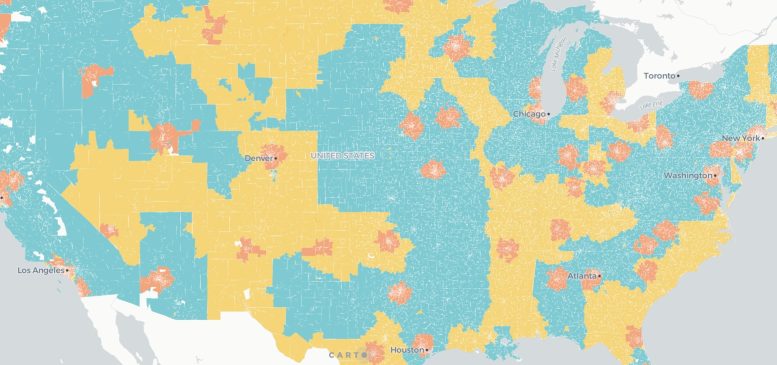
Here’s a map showing the implementations as of August 1, 2026. Blue indicates ZIP Codes where RTO has been activated; yellow is for areas that are eligible for RTO but that have not yet been activated; orange indicates the areas that are not eligible for RTC because they are within 50 miles of an RPDC. Search the map by place names or ZIP Code followed by USA.

Since May 1, 2025, the RTO has been activated at 10,500 post offices — an average of 950 post offices a month (not including December 2025, when there were no activations).

During the month of April 2026, the RTO was implemented at just over a thousand post offices, approximately the monthly average, but a significant increase over the previous two months. During February, RTO was activated at about 150 post offices, and in March, at about 500.

There are now about 8,000 more post offices eligible for RTO that have not yet been activated. At the rate of a thousand per month, the RTO could be fully activated by the end of calendar year 2026.

For more about RTO, visit our RTO Dashboard.

Post Office to exit historic Federal Building in Bozeman, Montana

Steve HutkinsBlog, Featured

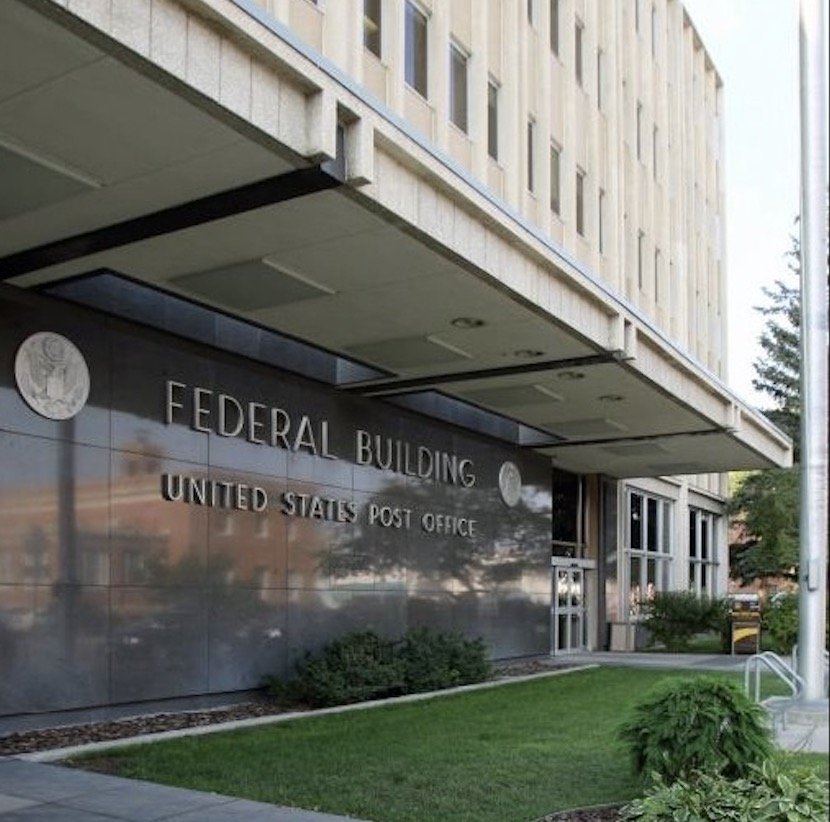
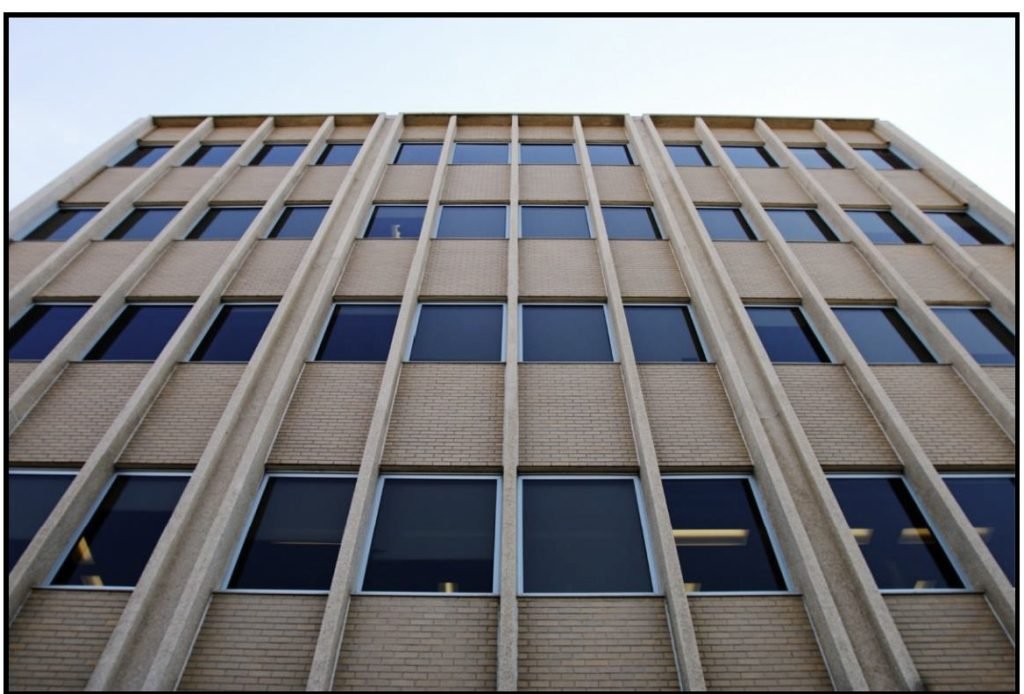
The Postal Service has announced plans to relocate the Babcock Station Post Office from its current location in the historic Federal Building at 32 E. Babcock Street in downtown Bozeman, Montana.

The announcement says, “The Postal service has been informed the lease will not be renewed at the building,” but it doesn’t say why, and it doesn’t mention that the building is under the jurisdiction of the General Services Administration (GSA).

The GSA’s decision to terminate the Babcock Station lease has naturally led to speculation (ss reported in the Bozeman Daily Chronicle)  that the Federal Building is being considered for disposal. 

The building was previously on a list of 430 potential property disposals put out by DOGE (Department of Government Efficiency) in March 2025. The list had twelve buildings in Montana.

The initial list was removed from the DOGE website after only a few hours. A revised list contained the Bozeman Federal Building on a list of 320 properties for disposal, but this list was also soon removed from the DOGE website. A current GSA list of assets identified for accelerated disposition contains about 50 properties. The Bozeman Federal Building is not among them.

Should the building go up for sale, it could be worth over $8 million. The Daily Chronicle says it was valued at $8,283,277, according to a 2025 appraisal.

History and architecture

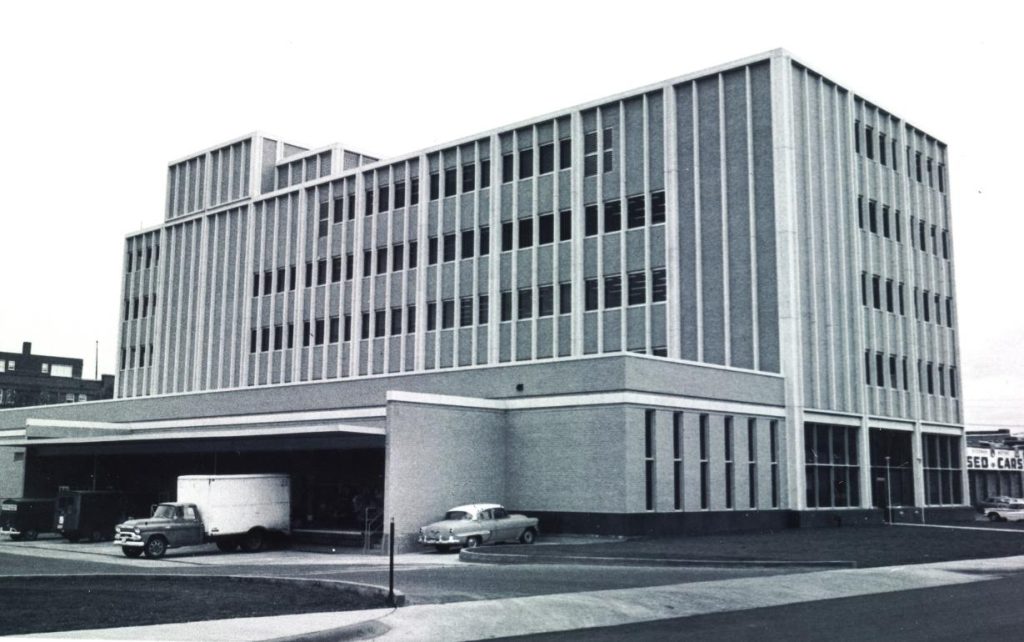
The Federal Building is a 97,000-square-foot facility that currently houses the U.S. Forest Service and other federal tenants..

The building is listed on the National Register of Historic Places. The nomination form from 2018 provides many details about the history and architecture of the building, as well as numerous photos. 

The building was constructed in 1966 after years of lobbying by local officials and business leaders who wanted to replace the 1916 post office, which had become inadequate, and to centralize the city’s federal offices, which had been scattered across inefficient locations. Its construction formally recognized Bozeman as the primary hub for federal administration in Montana. 

The building was designed by Norman J. Hamill and Associates. As the National Register nomination observes, tt “embraces New Formalism in its inclusion of rhythmic elevations, carefully-scaled building components, classical inferences, and textural materiality.” It features a modern colonnade on a granite pedestal and a heavily glazed, transparent first floor that appears to support the upper stories.

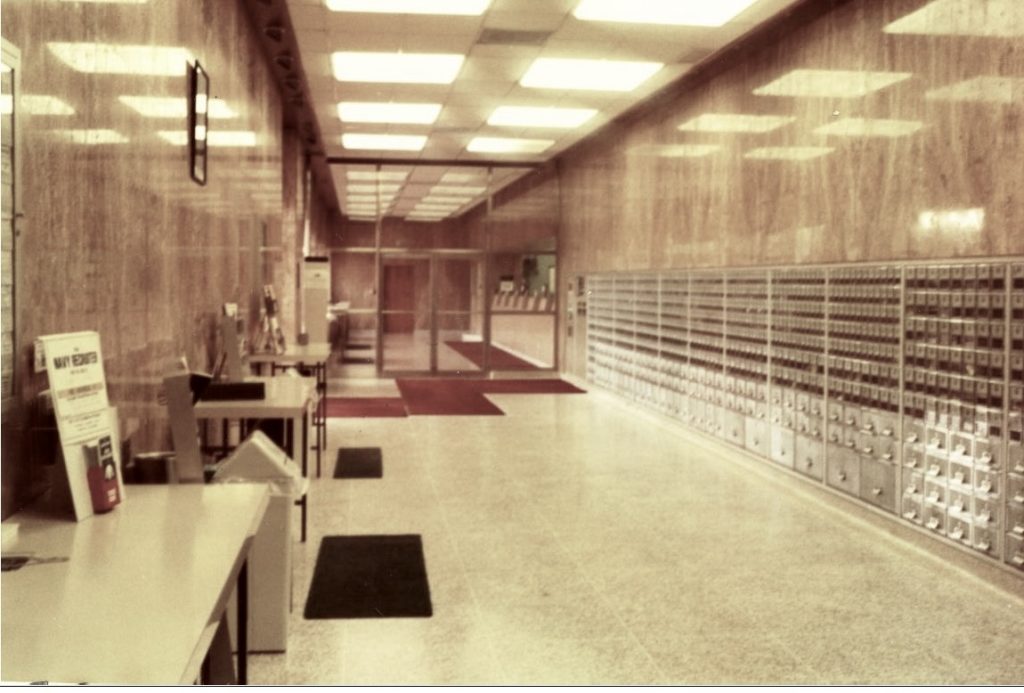
High-quality materials were used in the construction, including local elements like polished Oxford grey granite at the base and Montana travertine for the interior public lobbies.

The facility covers 2.15 acres and provides extensive parking. The public areas remain largely original, preserving the building as an architectural record of Bozeman’s mid-century modernization.

According to the NRHP nomination form, “Combined federal office buildings and post offices, such as the one at Bozeman, became the physical manifestation of government needs in regional centers throughout the country and often were the most prominent — if not only — federal building in the community or region, serving a critical role in supporting local economies.

“Throughout its 51-year history, the FB&USPO has continued to provide postal services for the benefit of the community and serve as the face of the federal government for the region, remaining a physical demonstration of the government’s commitment to maintaining a strong regional presence in Bozeman as expressed in 1966.”

A new location

In 2012, prompted by the high rent costs the GSA was charging the Postal Service, the USPS decided to move most of its operations out of the building. Letter carriers and some package handling operations were relocated to a new USPS-owned facility on Baxter Lane.

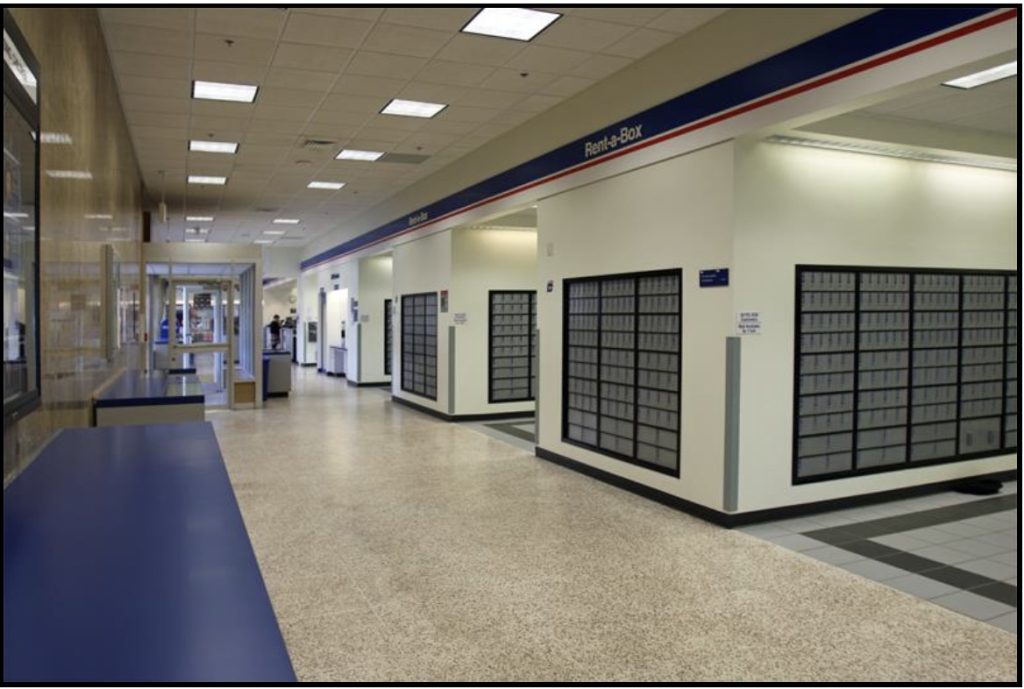
What remained in the Federal Building was a retail-only post office and PO Boxes called Babcock Statiion.

When the Postal Service leaves the Federal Building it will end a 60-year history in the space.

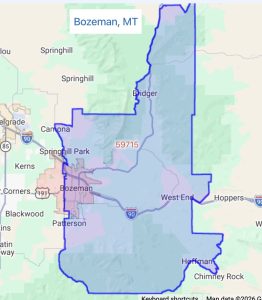
The agency says it is searching for a new space in ZIP Code 59715 that has approximately 4,800 square feet for a small retail office and that can accommodate at least 44 parking spaces for its operations. 

But ZIP Code 59715 is expansive, and committing to a new location in this ZIP Code doesn’t promise much. The urban area is about 12-20 square miles, but it also includes hundreds of square miles in the rural and mountain areas.

The announcement also says, “The relocation project will consist of procuring a suitable substitute location, as close as reasonably possible to the existing location.”

Finding a new retail space with 44 parking spaces in downtown Bozeman will be challenging. The historic core has limited on-site parking, and most small retail spaces have just a few dedicated spaces. 

59715

The Postal Service may need to look for a space in a shopping center, where shared parking is more available. There are several to choose from.

One potential location is Bozeman Commons (1101 E Main St), which is less than a mile from the Federal Building and a convenient 15 minute walk along the highly walkable East Main Street.

Another possibility is the historic Westgate Village Shopping Center, about two miles from Federal Square. Built in 1957, it was the first shopping center in Bozeman, and in August of 2024 it was listed on the National Register of Historic Places.

Then there’s the Bozeman Shopping Center (1575 W Main St), just over a mile from the Federal Building.

The new Bozeman Square (7th and E. Oak) is yet another possibility, but it may be a while before this property is ready for occupancy.

Submitting comments

Customers of the Babcock Station have been invited to submit written comments about the relocation proposal, and they can weigh in on the potential new locations. Unfortunately, these comments will not be made public, and there won’t be a public meeting to to ask questions, discuss the proposal and consider possible alternative spaces.

That’s because a few years ago the Postal Service revised its regulations to eliminate the requirement for a public meeting on relocations. That decision was based on the Postal Service’s practices during the pandemic, when public meetings weren’t possible. (These regulations are spelled out in 39 CFR § 241.4. The changes regarding a public meeting were announced in the Federal Register in June 2023.)

Comments on the proposal may be sent to United States Postal Service, Attn Bozeman MT Babcock Station Relocation, PO BOX 27497, Greensboro, NC 27498-1103.

The deadline for comments is 45 days from the date of the announement, April 23, which puts it at Sunday, June 7.

— Steve Hutkins

Featured Image: Historic Bozeman

Agencies delay action on Trump mail voting order amid legal fight over authority

Steve HutkinsNews

Government Executive: Federal agencies say they have yet to take steps to implement President Donald Trump’s executive order restricting voting by mail, as the Department of Justice fights a Democrat-led lawsuit against it.

The Justice Department late Friday filed documents asking a federal judge to dismiss the lawsuit and to not block the executive order on a preliminary basis because the order has not been implemented. The filings marked the Trump administration’s first effort to defend the order in court.

The March 31 order directs the creation of state citizenship lists and restricts how ballots can be sent through the mail, instructions that Democrats and election experts have called unconstitutional and illegal. It comes as Trump has seized on the specter of noncitizen voting, an extremely rare phenomenon, to demand sweeping voting restrictions.

In its Friday filing, the Justice Department sought to persuade Judge Carl J. Nichols in U.S. District Court in the District of Columbia that a legal challenge is premature.

“If and when the Executive Branch takes some action to implement the Executive Order,” then a lawsuit can be brought, Stephen Pezzi, a senior trial counsel in the Justice Department’s Civil Division, wrote in a court filing.

Nichols has scheduled a hearing for May 14.

Read more; No

Postmarks delayed, ballots denied: Warnings flash in Washington

Steve HutkinsBlog, Featured

A cost-cutting change to how the Postal Service handles outgoing mail at post offices is quietly undermining the vote-by-mail process. In states that rely on Election Day postmarks, a growing share of ballots are being rejected — not for arriving late, but for lacking a timely postmark.

Earlier this week, a special election was held in Washington state, with counties voting on school budgets, bond issues, and other local measures. In advance of the election, state officials urged voters to use ballot drop boxes rather than the U.S. mail. They warned that recent changes at the Postal Service put ballots at risk of being rejected due to late postmarks.

According to the Washington Secretary of State, in the 2024 presidential election, about 4,600 ballots were disqualified for late postmarks. In the special election in November 2025, the total number of ballots was half that of 2024, yet the number of late-postmark rejections jumped to nearly 15,000.

In California, election officials have also sounded the alarm. As reported in the Los Angeles Times a few weeks ago, in the special election in 2025, the rejection rate for late ballots was four times higher than in the 2024 election.

States with postmark deadlines (Source: Ballotpedia)

The problem is not confined to California and Washington. There are currently 14 states, plus the District of Columbia, that accept ballots after Election Day if they have a postmark on or before Election Day. With recent rejection rates like those in California and Washington, the number of disqualified ballots could surge in the November midterms.

A case currently before the Supreme Court could lead to another outcome, however.  Watson v. Republican National Committee involves a challenge to the practice of accepting ballots during a grace period after Election Day. If the Court rules that this grace period is unconstitutional, all mail ballots in national elections would need to be received at election centers by Election Day. The postmark would become irrelevant.

But if the Court doesn’t announce a decision before the November midterms, or if it decides to permit states to continue using the postmark deadline, the Postal Service’s change in postmarking practices could end up disenfranchising thousands of voters and have a significant effect on the outcome of close races.

The RTO’s impact on postmarks

Traditionally, mail is collected at the end of the day and transported to processing centers, where letters are scanned and postmarked, almost always on the same day they were sent. 

This same-day postmark is the foundation for the mailbox rule aka the posting rule, a legal concept used in tax law, contracts, and elections where “timely mailing is treated as timely filing.” In the context of U.S. tax law, the concept is codified in 26 U.S. Code § 7502.

In 2024, the Postal Service began an initiative called Regional Transportation Optimization (RTO). Under RTO, the mail is no longer collected at the end of the business day. Letters are instead bagged and held at the post office until the following morning, when they’re collected at the same time the day’s mail is dropped off for delivery. By combining delivery and collection into a single trip, the Postal Service cuts its costs

However, this change in the transportation system means that letters which would have otherwise been postmarked the day they were sent are instead postmarked a day later. A voter might deposit a ballot on Election Day, but the postmark will show the following day, leading to a disqualified ballot. 

Even a ballot mailed on the Monday before Election Day — if it’s deposited after the final bagging of the mail for a Tuesday morning pickup — may not be postmarked until Wednesday — too late to be counted as valid.

RTO Implementation as of 4/1/2026 (Source: Save the Post Office)

The RTO applies only to post offices more than 50 miles from one of the country’s 56 Regional Processing & Distribution Center (RPDCs). Post offices outside this radius are subject to RTO.

The plan has been implemented region by region for the past two years. When it’s fully implemented, the RTO will affect about 24,000 of the 31,000 post offices nationwide. As of April 1, 2026, the plan had been activated at about 14,300 post offices.

At this point, the plan has impacted about 88 million people nationwide. Eventually, the RTO will encompass 156 million people — nearly half the country’s population.

You can check the RTO status of any location using the RTO Status Checker in the sidebar on this page. Type in a ZIP Code or a place name and state, and hit enter. The Checker will indicate if a location has already been activated for RTO,  if it’s eligible for RTO but not yet activated, or if it’s exempt from RTO because it’s within 50 miles of a RPDC.

RTO implementation in Washington

In Washington, about 330 of the state’s 520 post offices have lost the evening collection under the RTO. About one-third of the state’s population live in RTO-impacted ZIP Codes.

Washington is served by three RPDCs — in Seattle, Spokane, and Portland. Post offices within 50 miles of these RPDCs are not affected by RTO, and ballots sent at these offices will presumably continue to get a same-day postmark.

In Washington, the RTO was activated in three phases. The first phase took place in February 2024 as part of the RTO pilot, Local Transportation Optimization (LTO). This activation impacted areas in the southwestern part of the state (ZIP prefix 986), which are served by the RPDC in Portland. 

The second phase, implemented in August 2025, covered the eastern half of the state (ZIPs 988-991 and 993-994). The third phase, implemented on November 15, 2025 (a week after the special election), impacted the northwestern part of the state (ZIPs 980-983, 985).

Here’s a map showing the phases of RTO implementations. The yellow areas indicate the ZIP codes within 50 miles of one of the three RPDCs. The green shows phase one, the light blue, phase two, and the dark blue, phase three. Scroll over the map for details.

The 2024 election would have been impacted only by the phase one RTO activations. The election in November 2025 would have been impacted by both phase one and phase two. By the date of the special election in February 2026, the RTO was implemented throughout the state.

Washington elections 2022-2026

Washington uses an all-mail election in which ballots are sent to all registered voters. About two-thirds of the ballots are returned via drop boxes, usually located near city hall, schools, and election centers, while about a third of the ballots are returned through the Postal Service. In 2026, over 44 percent of the votes were sent through the Postal Service.

In this discussion, “mail ballots” refers to those returned by postal mail, not drop boxes.

Here’s a table showing election results in Washington for the 2022 midterms, the 2024 presidential election, and two special elections in 2025 and 2026.

YearBallots ReceivedBallots returned via MailTotal RejectedLate PostmarkOther reasons% of Rejected for Postmark% of Received Rejected for Postmark% of mail ballots with late postmark
20223,108,2711,195,58238,2378,35829,87921.86%0.27%0.70%
20244,006,6741,310,40237,8124,60033,21212.17%0.11%0.35%
20252,025,271699,67122,85114,7418,11064.51%0.73%2.11%
2026785,570349,02214,20810,4863,72273.80%1.33%3.00%

Late postmarks represent a growing portion of rejected ballots. In 2022, they accounted for 22 percent of rejected ballots. By 2026, that figure skyrocketed to 73 percent. Here are a couple of charts showing reasons for rejection in 2022 and 2026.

Reasons for Ballot Rejections in 2022 and 2026

In 2022, the statewide late postmark rejection rate as a percentage of mail ballots was 0.69%, representing 8,358 rejections out of approximately 1.21 million mail ballots. In 2024, the rejection rate due to late postmarks declined somewhat, as is typical in presidential elections (as discussed below). In 2024, there were 4,600 late postmark rejections,  0.34 percent of mail ballots.

The situation shifted radically in the special elections in 2025 and 2026. In 2025, the rejection rate due to late postmarks surged to 2.09 percent of mail ballots (14,741 rejections out of 705,984 ballots), and in the February 2026 special election, the rate reached 3 percent, with 10,486 rejections out of a much smaller pool of 350,670 mail ballots. 

If the rejection rate in the upcoming midterms reaches the 2026 level of 3 percent and the number of mail ballots is similar to the 2022 level of 1.2 million, it would mean about 36,000 ballots could be rejected due to late postmarks — more than four times as many rejections as in 2022.

Rejections in off-year elections

As the table above shows, the rejection rate in 2024 was lower than in the off-year elections, and the two special elections have notably higher rates. This a common phenomenon for which there are several explanations, as discussed in this report on ballot rejections in Washington State 2020-2024.

Off-year elections tend to attract a higher proportion of infrequent or first-time voters who are less familiar with the specific “must be postmarked by Election Day” rule. These elections also have a relatively low profile, so some voters may not realize it’s Election Day until the last minute, so they rush to the post office and miss the deadline.

In addition, high-profile presidential campaigns invest heavily in “ballot curing” outreach, helping voters fix mistakes before they lead to final rejections. In off-years, this support network is largely absent.

While voter behavior thus accounts for some historical variation, the sharp spike in late-postmark rates in 2025 and 2026 is almost certainly due to changes in Postal Service postmark practices.

Election impacts of RTO

To get a clearer sense of the extent to which late postmarks as opposed to voter behavior are causing ballot rejections, one can contrast areas where RTO has been implemented with areas that are excluded from RTO because they’re near an RPDC.

The Postal Service is implementing the RTO in ZIP Codes where the post office is more that 50 miles from a RPDC. Washington reports election data by county, and some counties include both RTO and not-RTO ZIP Codes. For purposes of this analysis, the counties with a relatively low percentage of the population subject to RTO are considered “not RTO” counties. For the Seattle RPDC, this includes King, Pierce, and Thurston counites. The Spokane RPDC area includes Spokane and Lincoln (two-thirds of its population are not-RTO) The Portland RPDC area includes Clark, Cowlitz and Skamania.

Here’s a table showing the mail ballots and postmark rejection rates for the four elections comparing counties where RTO was implemented with those where RTO was not implemented.

YearTotal Mail BallotsTotal Rejected LateTotal Rejection RateNot RTO Mail BallotsNot RTO Rejected LateNot RTO Rejection RateRTO Mail BallotsRTO Rejected LateRTO Rejection Rate
20221,195,5828,3580.70%734,5665,2860.72%461,0163,0720.67%
20241,310,4024,6000.34%816,4582,9750.36%532,3391,6250.31%
2025699,67114,7412.09%433,9376,8151.57%272,0477,9262.91%
2026349,02210,4862.99%180,0722,5771.43%170,5987,9094.64%

Here’s a chart, based on that data table.

In the counties not impacted by RTO, the late-ballot rejection rate increased from 0.72 percent in 2022 to 1.43 percent in 2026. This increase would have had nothing to do with RTO. It’s primarily due to voter behavior. 

The rejection rate for the RTO counties, on the other hand, increased from 0.67 percent in 2022 (similar to the not-RTO rate) to 4.64 percent in 2026. Some of this dramatic seven-fold increase was caused by voter behavior, but most of it was due to the RTO.

Counting by county

These numbers represent the aggregate totals for RTO and not-RTO counties. The following table drills down to the county-level and compares the 2022 midterms and the 2026 special election (at which point the RTO had been implemented throughout the entire state).  The counties with an activation date of N/A are those within 50 miles of a RPDC and therefore not-RTO.

CountyRTO Activation Date2022 Total Mail Ballots2022 Rejected for Late Postmark2022 % Rejected for Late Postmark2026 Total Mail Ballots2026 Rejected for Late Postmark2026 % Rejected for Late PostmarkChange in % Rejected 2022 to 2026
StatewideN/A1,915,5828,3540.44%349,02210,4863.00%689%
Adams8/9/20251,710140.82%1,161332.84%347%
Asotin8/9/20254,303170.40%2,1851125.13%1297%
Benton8/9/202524,2091520.63%15,5135723.69%587%
Chelan8/9/202511,311780.69%8,0023394.24%614%
Clallam11/15/202510,458360.34%00N/AN/A
ClarkN/A80,4186320.79%13,0581301.00%127%
Columbia8/9/202578150.64%4000.00%0%
CowlitzN/A12,303660.54%4,491912.03%378%
Douglas8/9/20255,220320.61%3,6201303.59%586%
Ferry8/9/20252,17410.05%1,059222.08%4516%
Franklin8/9/20258,143630.77%5,6792985.25%678%
Garfield8/9/202542910.23%01N/AN/A
Grant8/9/202510,9951111.01%3,6601855.05%501%
Grays Harbor11/15/202524,660660.27%5,3262164.06%1515%
Island11/15/202516,168590.36%4,7692034.26%1166%
Jefferson11/15/202511,207220.20%6,9341942.80%1425%
KingN/A358,4142,7520.77%85,0781,2481.47%191%
Kitsap11/15/202534,4162750.80%8,1872352.87%359%
Kittitas8/9/20256,126370.60%2,6311274.83%799%
Klickitat2/24/20242,675150.56%1,424292.04%363%
Lewis11/15/202515,977770.48%4,3941463.32%689%
LincolnN/A4,402140.32%1,565161.02%321%
Mason11/15/202511,311560.50%2,173783.59%725%
Okanogan8/9/202510,059550.55%1,041363.46%632%
Pacific2/24/20246,289230.37%2,215954.29%1173%
Pend Oreille8/9/20253,752160.43%2,626702.67%625%
PierceN/A114,6971,1861.03%56,1918191.46%141%
San Juan11/15/20254,353100.23%563122.13%928%
Skagit11/15/202516,4721320.80%8,9543774.21%525%
SkamaniaN/A1,762100.57%1,183221.86%328%
Snohomish11/15/2025118,7279030.76%57,1553,7096.49%853%
SpokaneN/A121,3074730.39%4,397280.64%163%
Stevens8/9/202516,293560.34%3,198300.94%273%
ThurstonN/A37,7603380.90%13,4522231.66%185%
Wahkiakum2/24/20241,04860.57%66140.61%106%
Walla Walla8/9/20258,160370.45%6,5222684.11%906%
Whatcom11/15/202533,3822460.74%00N/AN/A
Whitman8/9/20258,219540.66%2,197381.73%263%
Yakima8/9/202538,3312280.59%8,3623504.19%704%

In some cases the county data samples are too small to be useful. But consider Snohomish County, where in 2022 about 900 ballots were rejected for a late postmark out of 118,727 mail ballots, a rejection rate of 0.76 percent. In 2026, 3,709 ballots were rejected out of only 57,155 — a rejection rate of 6.49 percent.

Franklin County saw a similar increase — from 0.77 percent in 2022 to 5.25 percent in 2026. In Yakima County, the rejection rate went from 0.59 percent in 2022 to 4.19 percent in 2026. These seven- and eight-fold increases in rejection rates for RTO counties may be contrasted with the non-RTO counties, where there were much more modest increases. Spokane went from 0.39 percent to 0.64 percent. King increased from 0.77 percent to 1.47 percent.

Here’s a map showing the rejection rates in 2026.

District by district

The impacts of RTO are not evenly distributed across the state’s ten Congressional Districts. In some, like the 7th, 9th and 10th, the percent of the population that’s subject to RTO is very small, while the 4th District is entirely subject to RTO.

Here’s a table showing the percentage of the population in each district subject to RTO. The column for RTO TBA is for ZIP Code areas that are eligible for RTO — they’re more than 50 miles from a RPDC — but that have not yet been activated for RTO, for one reason or another. It’s possible that that the plan has been tweaked somewhat and they will not be RTOed.

DistrictNot RTORTO ActivatedRTO TBATotal PopPercent of Pop RTO
1st329,244341,702100,730771,67644.28%
2nd58,846636,63844,810740,29486.00%
3rd628,071164,4391,018793,52820.72%
4th668,4330668,433100.00%
5th565,195309,9640875,15935.42%
6th417,570339,1145,482762,16644.49%
7th794,886794,8860.00%
8th647,429226,775874,20425.94%
9th705,831705,8310.00%
10th630,42145388,220719,0940.06%
State4,777,4932,687,518240,2607,705,27134.88%

Here’s a map showing the districts, color-coded by the percent of the population subject to RTO. The darker the shade of blue, the greater the percent of the population subject to RTO.

Generally speaking, the districts with a high RTO percentage are more rural — and more Republican-leaning — than those with a low RTO percentage, which tend to be urban and to vote Democratic. In the districts where the RTO percentage is in the mid-range, the RTO voters tend to live in the rural areas of the district while the non-RTO voters live in the metropolitan areas around Spokane, Seattle, and Portland.

Most of the state’s districts have a history of going strongly for one party or the other, so it’s likely that RTO impacts, even if they surge in 2026, will not affect the outcome of any race. But there’s at least one notable exception.

According to Cook’s Political Report, the 3rd District, which encompasses southwest Washington, is a competitive “purple” district. In 2024, the 3rd voted for Trump for president while electing a Democrat to the House (with a margin of 16,123 votes). It’s the kind of district in other parts of the country where disqualified ballots could make a difference.

Alerting the public

The Postal Service has been sharing information about its postmarking practices with election officials, a Federal Register notice, and postings on its website. The Postal Service is telling voters to request a hand-stamped postmark at the counter in the post office to ensure their ballot is dated correctly.

But this assumes that voters will know about the postmark problem. They can’t be blamed if they don’t get the message. There are no signs at RTO post offices alerting customers that their mail won’t be collected and postmarked until the next day. Many voters are unaware that their long-standing habits may now lead to their votes being discarded. 

Postmark infographic (Source: Nonprofitvote.org)

State election offials are urging voters to use drop boxes instead of the Postal Service, but in some rural areas, the post office may be more convenient, and it may be a matter of habit to use the postal system. It’s voting-by-mail, after all.

In the November midterms, there may be dozens of toss-up districts, as well as a few close Senate races. Some will involve states where there’s a significant number of mail ballots.

If the Supreme Court does not intervene via Watson v. Republican National Committee — which could potentially eliminate the postmark grace period entirely — these “arcane” postal changes may decide the outcome of the nation’s closest races.

The Washington State election data can be found on the Secretary of State’s website. There’s a thorough annual report on the 2025 election in Washington here. The data used for this post can be found on Google Docs here. You can check the RTO status of any ZIP Code or location on the RTO Status Checker in the sidebar of this website. There’s more about the postmarking issue here, and more about the RTO on our RTO dashboard.

— Steve Hutkins