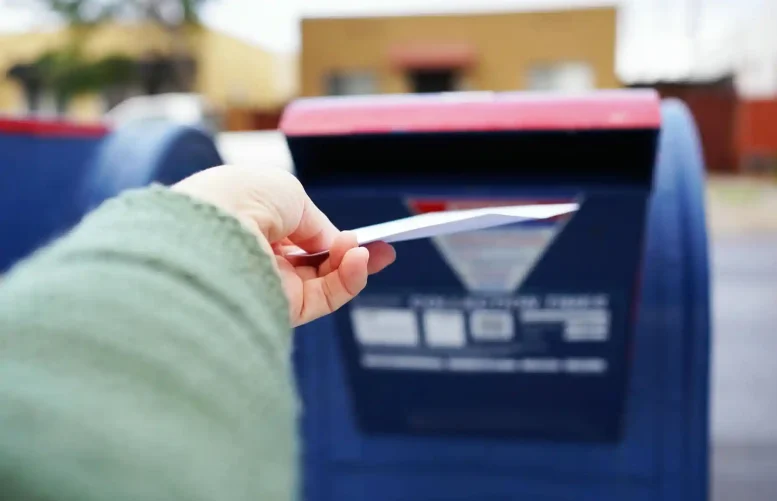
Brookings: Every election cycle, tens of millions of Americans vote without setting foot in a polling place. Their local election office mails them a paper ballot, they mark it at home, and they hand it back to a letter carrier to return. Over the past three decades this has grown from a niche convenience into how almost a third of the country votes: the share of voters casting a ballot by mail rose from 7.8% in 1996 to 21% in 2016, surged to 43% in the pandemic election of 2020, and settled at 29% in 2024 (Figure 1). In that election, the U.S. Postal Service (USPS) carried roughly 99 million ballots to and from voters.
That national average masks wide variation among the states: in Oregon and Washington, more than 95% of voters cast their ballots by mail, while in West Virginia and Tennessee fewer than 3% do (Figure 2). Eight states and the District of Columbia now mail a ballot to every registered voter, while elsewhere voters must request one, often only if they have a specific reason for doing so. That approach began in the West, where Oregon became the first all-mail state in 2000 and much of the region followed. What determines a state’s mail-voting rate is this policy, not its geography: where a ballot arrives automatically, most voters use it; where it must be requested, as in rural West Virginia and Tennessee, far fewer do.
That scale turns a question most people never think about into an urgent one: what, exactly, is the Postal Service’s job in an election? The short answer is that USPS is a carrier, not an election administrator. It moves ballots quickly, neutrally, and at scale when states choose to run elections by mail, but it does not decide who may vote, how ballots are designed, or which ones count.
Several recent developments are converging on that narrow role. A Supreme Court ruling has reaffirmed that states can rely on postmarks as proof of timely voting at the same time the Postal Service’s own cost-cutting network overhaul has widened the gap between when voters hand a ballot to the post office and when it gets postmarked. A deepening financial crisis in the postal service, the reason for the overhaul, leaves the agency with little slack to absorb anything new. And a 2026 Trump administration executive order would push USPS to do the one thing it has always insisted it does not do: judge who may vote by mail, and refuse to carry the ballots of those who don’t comply.
The Postal Service moves ballots quickly, but on terms that others choose
The Postal Service’s role is to deliver the mail. That’s the core mission. When states choose to run elections by mail, USPS’s job is to move ballots reliably and without favor, just as it handles every other piece of mail. Mail-in voting has been part of that delivery since 1864.
USPS doesn’t treat ballots as a special class of mail. Ballots travel to voters as either First-Class Mail, which has a shorter delivery window and can go by air, or Marketing Mail, which has a longer one and travels by ground. Election officials make that choice, not USPS. In 2020, more than 70% of outbound ballots went as Marketing Mail, the slower option. That choice, like nearly all other consequential decisions about how ballots move, belongs to the thousands of local election officials who use the mail, not to the Postal Service.
When election officials want better handling, USPS offers a formal toolkit outlined in the Election Mail Kit. Election officials can apply for the Official Election Mail logo on their envelopes, a visual signal to postal workers that a piece is a ballot. USPS can assign each ballot a unique barcode that allows real-time tracking. Election officials get a free design review from a USPS Mailpiece Design Analyst to optimize delivery speed. USPS offers Informed Visibility tracking, so officials can see exactly when ballots arrive and from where. And the Postal Service assigns dedicated Election Mail Coordinators to larger jurisdictions to help with planning and logistics. These tools are “strongly recommended” but optional.
In the weeks before Election Day, USPS shifts into an operational mode designed for ballots. Election Mail gets priority treatment regardless of which class an election official chose. USPS conducts daily facility sweeps to identify and extract ballots from the mail stream. Extra transportation runs move ballots directly from processing facilities to election offices, bypassing the normal regional sorting network. USPS processes mail on Sundays, something it doesn’t normally do. Ballots get expedited handling equivalent to Priority Mail Express. This operational surge comes at a cost. In 2020, extraordinary measures drove transportation trips up 35% and overtime costs up 30% in October and early November.
The result in 2024 was swift delivery: ballots reached election officials roughly one day on average after voters handed them to the mail. These speed figures, however, capture only ballots USPS could identify and track. By the Postal Service’s own estimate, nearly 40 million ballots it moved to and from voters that year went untracked.
The Postal Service is a carrier, not an election administrator
For all that it does, the Postal Service is not an election administrator, and it says so plainly. “The Postal Service’s role is clear,” the agency wrote after the 2024 election. “We deliver the mail.” In the same report, USPS set out the decisions that are not its to make: election laws and deadlines, ballot envelope design, ballot counting, and “the extent to which election laws rely on a postmark in determining whether a ballot is timely.”
A postmark, though, is two different things depending on which system is reading it.
To the Postal Service, a postmark is simply part of standard mail processing: the mark is typically applied to void a stamp—an action termed cancelation—so it can’t be reused. It’s typically applied at the processing facility, dated to the first automated processing operation. However, USPS doesn’t postmark every piece: some mail, like bulk mail, receives no postmark at all. In December 2025, USPS added a new section to its Domestic Mail Manual, “Postmarks and Postal Possession,” formally acknowledging that a postmark’s date “does not inherently or necessarily align with the date on which the Postal Service first accepted possession of the mailpiece,” and that this “lack of alignment has and will become more common” as its network changes.
Authority over American elections is highly decentralized. The Constitution assigns it to the states, which in turn hand most of the administration to local officials. There are more than 10,000 election jurisdictions in the United States, and USPS coordinates with roughly 8,000 local election boards. The rules vary not just from state to state but from one jurisdiction to the next within a single state.
Nearly every choice that determines how a ballot moves belongs to those officials, not to USPS. They design the ballot and the envelope. They pick the mail class, First-Class or the slower Marketing Mail. They decide whether to use USPS’s voluntary tracking tools, whether to prepay return postage, who receives a ballot, and, critically, when to mail ballots out. That last choice can be decisive: in 2024, officials sent 150,630 ballots to voters in the final week before the election, 31,260 of them on Election Day itself, leaving little time for those voters to return them by mail. State law, in turn, sets the request and return deadlines, whether a postmark governs timeliness, who is eligible, whether drop boxes are allowed, and whether voters can fix a rejected ballot. USPS carries, processes, and delivers what those thousands of jurisdictions hand it, to whatever standard they chose.
For more than a century, this division of labor has been stable: the Postal Service carries, and states and localities administer. That arrangement is now under pressure from several directions at once: a Supreme Court decision that leans on the postmark, a network redesign that undermines it, a financial crisis that constrains what the agency can absorb, and an executive order that would recast the carrier as a gatekeeper.