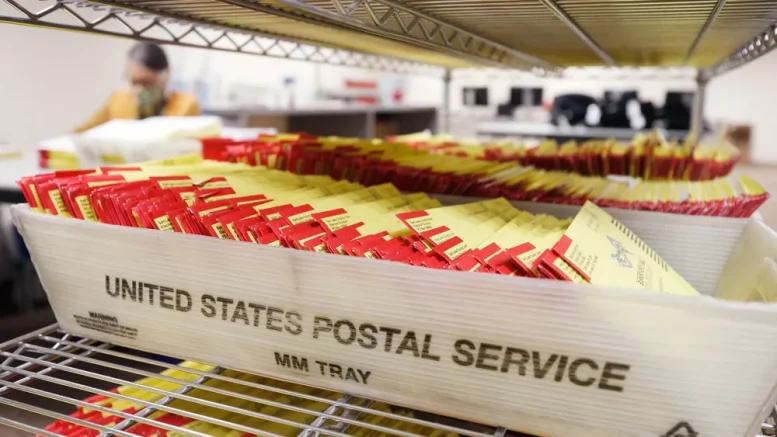
The Postal Service’s Regional Transportation Optimization (RTO) initiative has raised serious concerns about a potential surge in ballot rejections in the November election. A few days ago, the USPS issued new instructions to postal employees that should address some of these concerns.
Under RTO, mail is held overnight and transported to a processing plant the next day rather than on the day sent. That adds a day or more to delivery times and means the postmark, which is applied at the processing center, may not show the date sent.
There is growing evidence that these changes have been causing more ballots to be rejected for being late. Studies of the 2025 elections and the 2026 primaries identified significant increases in late-arriving ballot rejections associated with RTO.
According to figures reported by the California Voter Foundation, approximately 93,500 mail ballots were rejected for lateness in California’s June 2026 primary, compared with roughly 31,000 in the November 2024 general election. Although the number of mail ballots cast declined from about 13 million to 8.4 million, the late rejection rate rose from 0.24% to 1.11%.
Those 93,500 rejections were almost as many rejections for lateness as the entire country experienced in the 2024 election when, according to the Election Administration and Voting Survey (EAVS), about 103,000 mail ballots were rejected for being late.
 A recent Brookings analysis found that RTO nearly doubled the rate of late-ballot rejection in the 2026 federal primaries. The study estimates that if a similar effect occurred in November, it could produce roughly 43,000 to 55,000 additional late ballot rejections.
As in past elections, the Postal Service has announced Extraordinary Measures to handle ballots for the November election. This time around, some of the measures are specifically designed to prevent RTO from causing a spike in rejected ballots.
A good performance delivering ballots in the midterms could help improve the Postal Service’s reputation, which has taken a beating lately.
An NBC report a few days ago found that the high-profile legal battle over Trump’s directive to the USPS on handling ballots, which ended up in the Supreme Court, “magnified worries about the reliability of the Postal Service.” Some voters are deciding they can’t trust the postal system to handle their ballots at all.
Which post offices are RTO?
RTO applies to post offices more than 50 miles from one of the new network’s 56 Regional Processing & Distribution Centers (RPDCs). The Postal Service has been implementing the activations incrementally, starting in 2024. When the plan is fully implemented, it will affect over 21,200 post offices and, since some offices handle mail for more than one ZIP, about 28,400 ZIP Codes. About 10,000 post offices and 12,000 ZIP Codes are excluded from RTO because they’re near a RPDC.

| City, State ZIP | RTO Status | Activation Date | PO Address | Campus Site | RPDC |
|---|---|---|---|---|---|
| Weems, VA 22576 | RTO Activated | 10/28/2023 | 3960 WEEMS RD | RICHMOND VA | RICHMOND VA RPDC |
You can see the RTO status of your ZIP by using the status checker widget. Just enter a city, state or ZIP. There is also an excellent RTO finder on this website with more information about RTO for each ZIP.
This map shows the status of RTO implementation as of October 1, 2026. The blue areas are where RTO has been activated, the orange where it will eventually be activated, and yellow where it will not be activated (ZIPs near the RPDCs). You can also search this map by place or ZIP (enter “USA” after the ZIP). To pan, hold down the Command (⌘) key and drag the map using one finger on your trackpad (or left-click and drag with a mouse). To zoom in and out, hold down the Command key and swipe up or down using two fingers.
RTO and election deadlines
Using data from the 2022 and 2024 general elections, Brookings estimated that an average of 16.6 million mail ballots, about 40 percent of the total number of mail votes, came from areas where the nearest post office is now designated for RTO. This includes ballots returned through drop boxes or directly to election officials, not just those sent through USPS.
EAVS doesn’t report on the number of ballots sent through the postal system, but it does provide drop box numbers for most counties. Based on these, we estimate that in 2024 roughly 9.6 million ballots originated at post offices now under RTO — about 4.6 million in states that accept post-Election-Day ballots with a timely postmark and 5 million in states requiring receipt by Election Day.
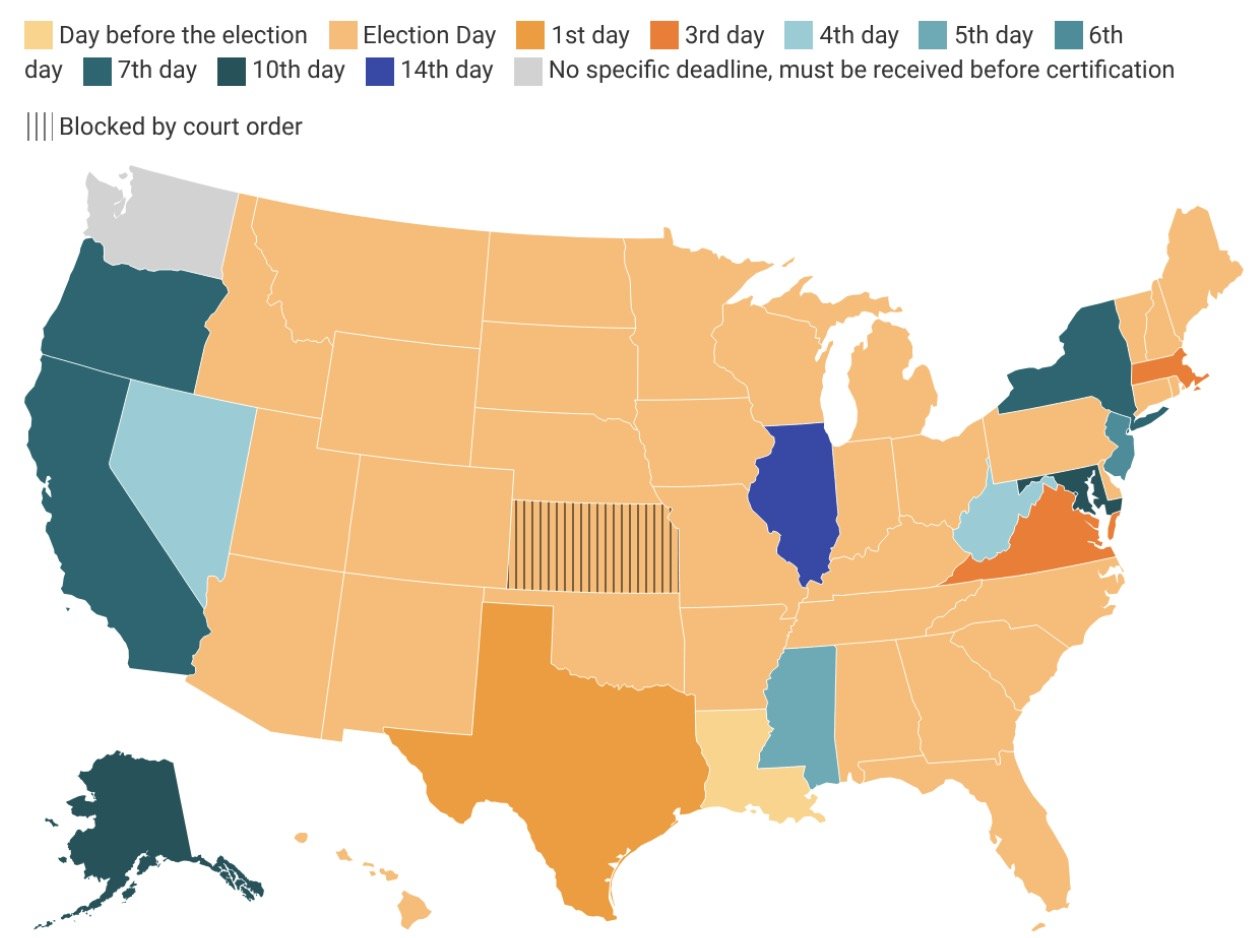
In states where ballots are counted if they arrive after Election Day so long as they were postmarked by Election Day, the principal RTO-specific concern is preserving the date on which the ballot was actually mailed. (The grace period after Election Day usually reduces the number of ballots arriving too late to be counted.)
Under the Extraordinary Measures, USPS requires identified return ballots collected at RTO post offices to be hand-postmarked on the day of collection, rather than waiting until they reach a processing center.
In states where ballots generally must arrive by Election Day, a postmark cannot save a ballot that arrives late. Here, the more important Extraordinary Measures are those designed to identify ballots and expedite their transportation to election officials.
Post offices that are not subject to RTO do not face these new RTO-related risks. Mail collected at non-RTO offices generally retain same-day transportation to an originating processing facility, avoiding the additional overnight hold imposed by RTO. These ballots will also be postmarked on the day sent, but this is not guaranteed, and voters may want to request a postmark if they are mailing close to the deadline.
The 2024 pilot and precedent
The 2026 Extraordinary Measures trace their current form to the 2020 election. USPS had expedited ballots in previous elections, but after operational changes and declining service performance threatened timely ballot delivery in 2020, federal courts ordered the Postal Service to formalize and expand practices such as extra trips, overtime and expedited handling of Election Mail. (Retired postmaster Mark Jamison, a regular contributor to Save the Post Office, provided expert testimony in one of those court cases.)
The Postal Service has implemented these extraordinary measures for the general elections in 2020, 2022, and 2024, but not special and primary elections. During the 2024 presidential election, these measures were expanded to include special procedures for the approximately 2,700 facilities then operating under Local Transportation Optimization (LTO), the pilot of RTO.
The 2024 measures included many of the same procedures being used in 2026: postmarking ballots at post offices and LTO hubs, local turnaround of ballots and hub-and-spoke transportation to bypass trips to a processing center, additional collections and deliveries, and other special processing methods to expedite ballots to election officials.
Overall, the 2024 operation worked well, with the USPS reporting that 97.73 percent of ballots were delivered from voters to election officials within three days, and 99.64 percent within five days, with an average delivery time within one day.
But an April 2025 audit by the USPS OIG identified some implementation problems.
Although the OIG found that USPS generally delivered Election Mail successfully, it identified confusion among employees about special procedures and temporary changes in mail flows, raising concerns about implementing those procedures on a much larger scale in 2026.
Most notably, some employees did not know their post office was under LTO, or that their facility had been designated as a hub, or that there were special hub activities they were required to follow. The OIG recommended that USPS better identify hub-and-spoke locations, including RTO sites, and communicate operational expectations before Extraordinary Measures began.
The scale is very different this year. The Postal Service was dealing with about 2,700 LTO-associated facilities during the 2024 election. RTO now encompasses about 17,000 offices — more than six times as many.
The 2024 experience therefore offers both reassurance and a warning. USPS has already demonstrated that Extraordinary Measures can help overcome the problems created by holding mail overnight. But in 2026, it must carry out these procedures across a vastly larger network.
Same-day postmarking at RTO offices
The Postal Service’s September 30, 2026 Extraordinary Measures memorandum establishes special election procedures beginning October 24 and continuing nationwide through Election Day, November 3. The measures remain in effect longer where state ballot-acceptance deadlines extend beyond Election Day.
There are currently 14 states (plus DC) in which ballots are accepted after Election Day if they have a postmark on or before Election Day. As of November, there will be about 6,600 RTO post offices in these states. The memo’s postmarking procedures will affect these offices the most.
Beginning October 26, the memorandum establishes the requirements for postmarking at RTO offices. The memo states that “Return Ballot Mail (completed ballots mailed by voters) destined for BOEs will be culled out of mail collected and brought back by carriers, and from all retail counters and all collection boxes/receptacles.” Every collection box must be collected at or after its posted collection time, not before. “Return Ballot Mail will be separated for BOE sites and postmarked (hand-cancelled) by managers on the day they are collected.”

Source: USPS
USPS is also authorizing several additional measures at post offices. Offices may establish dedicated “Ballot Postmark ONLY” lines staffed throughout operating hours. Where ballot volume warrants, they may establish staffed drive-through locations where voters can deposit ballots and have them postmarked immediately. Designated offices may also open 30 minutes early and close 30 minutes late.
If employees successfully identify and separate return ballots at RTO offices, voters should not ordinarily need to request a postmark themselves. But a voter who wants certainty can take a ballot to a retail counter and request a manual postmark at no charge.
A separate October 1 memorandum, “2026 Guidance on Postmarking Ballots,” reinforces the Postal Service’s general postmarking policy. Among other things, it instructs employees to ensure that identifiable return ballots receive postmarks even when they use postage methods that might not otherwise require cancellation.
It also makes an important point about missing postmarks. An originating facility may apply a postmark when the mailing date can still be established. But once a ballot has moved downstream, employees should not apply a postmark purporting to establish an earlier mailing date. In other words, a missing postmark should not simply be backdated later in the mailstream.
Expediting transportation from RTO post offices to election offices
Same-day postmarking solves one part of the RTO problem. The ballot still has to reach the election office by the deadline. This is particularly true for the 36 states where the deadline is Election Day, with no grace period. There are about 10,400 post offices now under RTO in these states.
USPS is authorizing a variety of measures to expedite ballots, including direct deliveries, special collections, hub-and-spoke transportation and other special handling. Beginning October 26, the Priority Mail Express network can be used when a completed ballot otherwise would not reach its destination before the state deadline. USPS is also requiring special processing plans immediately before Election Day, including Sunday processing and direct holdouts for return ballots.
The extra day (or two) in delivery times for ballots coming out of RTO offices contributed to a surge in rejected ballots in the special 2025 elections and the 2026 primaries, so expediting transportation out of these offices will be crucial in November.
For ballots originating at offices not subject to RTO, swift delivery is equally important. Overall, the Postal Service will handle something on the order of 25 million ballots in November. These ballots will originate at about 32,000 post offices, and they will be delivered to election officials serving nearly 8,000 election jurisdictions nationwide. Needless to say, ensuring that each ballot is delivered on time is a daunting task, especially when some voters choose to mail close to the deadline. These ballots will be delivered to election officials serving nearly 8,000 election jurisdictions nationwide
The hub-and-spoke system
The Extraordinary Measures call for delivering ballots from some RTO post offices directly to Boards of Elections. This “local turnaround” bypasses the time-consuming trip to and from a processing center. It applies when the post office is in the same ZIP code as the BOE and when ballots are transported to a hub facilities, where they are consolidated and then taken to the BOE or processing facility.
In the hub cases, the postmarks may be applied at the hub rather than at the post offices. At the hubs, employees are instructed to count the ballots, confirm that postmarks have been applied, document their receipt and arrange onward delivery.
The configuration of this hub network has not been made public. One possibility is that USPS could make use of an existing organizational structure created by POStPlan, the 2012 initiative that reduced hours and eliminated postmaster positions at thousands of small post offices. These Remotely Managed Post Offices operate under the postmasters at Administrative Post Offices. There are about 8,400 RMPOs and 3,700 APOs currently under RTO. If these RMPOs transported their ballots to the APOs, it would significantly reduce the number of direct trips to the BOEs. But this is just a hypothetical interpretation of the hub-and-spoke plan.
Ballots mail from post offices more distant from the BOE will need to move through the regular processing-and-transportation network. But the extraordinary measures provide various safeguards to ensure that ballots are identified and given special consideration. This applies to all ballots in the mailstream, not just those originating at RTO offices.
Data summary
Here’s a summary of our analysis of RTO impacts on the postal system and election mail.
| RTO status | Deadline | Facilities | ZIPs | POP | Mail ballots in 2024 | Late ballots in 2024 |
|---|---|---|---|---|---|---|
| RTO Activated | Postmark | 6,600 | 7,700 | 45.7 M | 4.6 M | 15,800 |
| RTO Activated | Election Day | 10,400 | 12,100 | 63.7 M | 5 M | 14,100 |
| RTO Activated subtotal | 17,000 | 19,800 | 109.4 M | 9.6 M | 29,900 | |
| Not RTO / TBA | Postmark | 6,000 | 8,300 | 110.5 M | 8.1 M | 35,800 |
| Not RTO / TBA | Election Day | 9,200 | 12,500 | 109.4 M | 12.4 M | 37,300 |
| Not RTO / TBA subtotal | 15,200 | 20,800 | 219.8 M | 20.5 M | 73,100 | |
| TOTAL | 32,200 | 40,600 | 330 M | 30.1 M | 103,000 |
In the table, “Not RTO” refers to post offices and ZIPs ineligible for RTO activation because they’re within 50 miles of a RPDC. “TBA” refers to offices and ZIPs that are eligible for RTO but are yet to be activated. Both groups will continue to get the evening collection as of Election Day.
The RTO facility and ZIP counts are based on the RTO update report shared by the USPS with the PRC on Oct. 7, 2026, and an earlier report (Jan. 16, 2026) shared with the PRC for its Annual Compliance review, which shows the most recent version of the RTO implementation plan.
The data on mail ballots and ballots rejected for lateness in 2024 are rough estimates based on a county-by-county analysis of the EAVS election data combined with estimates of the portion of each county’s population that will be subject to RTO as of the November election.
Will the measures solve the RTO problem?
On paper, the Extraordinary Measures address the two principal election risks created by RTO. Same-day hand-postmarking should protect the mailing date in states where the postmark matters, while direct deliveries, hubs and other expedited transportation should reduce the risk of late arrival in states with Election-Day receipt deadlines.
The main uncertainty is implementation. The 2024 election showed that Extraordinary Measures can work, but it also revealed some confusion over hubs and special procedures when the optimized network was much smaller. This year, similar procedures must be coordinated across over 17,000 RTO offices.
If employees carry the measures out as directed, they should substantially reduce the additional risk RTO would otherwise pose to mail ballots. The challenge is making sure that thousands of individual post offices consistently identify ballots, apply the required postmarks and move them into the expedited transportation network during the final days of the election.
For voters, the safest course remains to mail ballots as early as possible. Those mailing near the deadline who want certainty about the postmark can take the ballot to a Postal Service retail counter and request a manual postmark at no charge.
Voting deadlines, postmark requirements and ballot drop-off rules vary by state. Voters should confirm the applicable rules with their state or local election office.
For more about the RTO and election mail, visit our RTO dashboard.
— Steve Hutkins
(Featured image: George Frey / AFP via Getty Images)