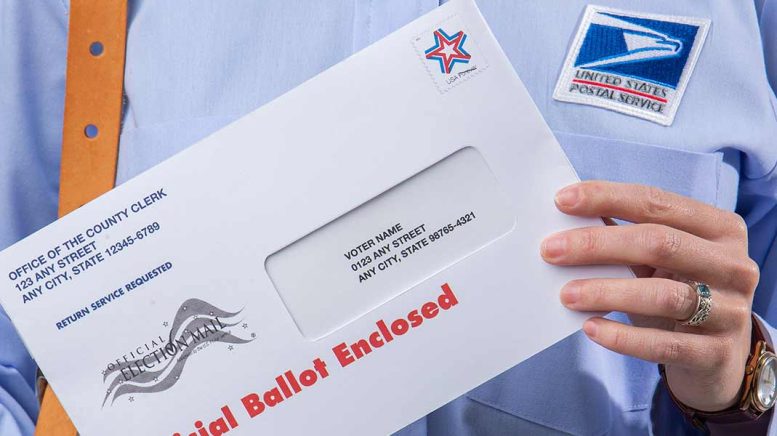
A petition filed Thursday with the Postal Regulatory Commission argues that the Postal Service cannot implement its proposed election-mail regulations without first obtaining a formal advisory opinion from the commission.
The petition was filed by Sai, a native U.S. citizen currently living in the U.K., who is the president of Fiat Fiendum, a nonprofit public charity organization that focuses on civil rights, social advocacy, voter education, campaign finance, and government transparency. Recently Sai has been challenging the Postal Service’s treatment of mailing to the blind in a complaint and extensive filings with the PRC (C2024-13).
Sai’s filing yesterday argues that the PRC is required to formally review the Postal Service’s proposed ballot-mail rule before it can take effect. The petition also asks the PRC to add Election Mail to the Mail Classification Schedule as its own class of Market Dominant Mail.
The Postal Service’s proposed rule change responded to a presidential executive order concerning federal elections. Among other things, the change in regulations would give the Postal Service an active role in determining which ballots may be carried through the postal system. (There’s more in this previous post and today’s New York Times.)
Sai’s petition argues that the Postal Service’s proposed changes should be reviewed by the PRC under the statute governing advisory opinions, 39 U.S.C. § 3661(b), which states:
“When the Postal Service determines that there should be a change in the nature of postal services which will generally affect service on a nationwide or substantially nationwide basis, it shall submit a proposal, within a reasonable time prior to the effective date of such proposal, to the Postal Regulatory Commission requesting an advisory opinion on the change.”
In the past, Section 3661 has been applied to proposed changes like eliminating Saturday delivery, mass closures of post offices, reducing operating hours at post offices (POStPlan), and revising service standards on delivery times. Most recently, the PRC conducted an advisory opinion on aspects of the Delivering for America plan that affect services, including eliminating evening collections at post offices (RTO).
Sai’s petition argues that the proposed ballot-mail rule clearly qualifies as a change in the nature of postal services on a nationwide basis and the Postal Service therefore cannot lawfully proceed without Commission review.
Under the statute, the Postal Service is supposed to request an advisory opinion before implementing such changes. The petition argues that the Postal Service is attempting to evade the required regulatory review by not requesting an advisory opinion.
The petition argues that if the Postal Service doesn’t request an opinion, the PRC should initiate such a review itself. As the petition states, the PRC “cannot abandon its statutorily obligated oversight duty and let the Postal Service choose when it does or doesn’t want oversight of its proposals to change the nature of service — let alone when it knows it is being circumvented.”
The Commission has never initiated an advisory opinion without a request from the Postal Service, but it has opened what’s called a Public Inquiry docket. That’s what happened when the Postal Service was dragging its feet on requesting an opinion on Delivering for America. Perhaps the Commission will do the same in this case as well.
While the Postal Service can claim to be exempt from the Administrative Procedure Act, the PRC cannot, claims the petition. The Postal Accountability and Enhancement Act (PAEA) (enacted in 2006) subjects the PRC’s actions — such as rulemakings for rate approvals — to the procedural requirements and judicial review standards of the APA. Under the APA, argues Sai, the PRC itself would need to conduct a proceeding on the proposed changes.
The petition therefore asks the Commission to open a formal Section 3661 proceeding by July 1, 2026 (when the public comment period on the Federal Register notice ends).
The petition also asks the PRC to require the Postal Service to disclose all public comments it receives regarding the Federal Register notice. Normally an agency summarizes the comments without publishing them, which places them, as Sai puts it, in a “black hole.”
The petition also focuses briefly on military and overseas ballots governed by the Uniformed and Overseas Citizens Absentee Voting Act (UOCAVA). The Postal Service says that its proposed rule does not currently apply to UOCAVA ballots, but the Federal Register notice invited public comments on those issues, which leaves open the possibility of future changes affecting military and overseas voters without adequate notice.
The petition therefore asks the Commission to require the Postal Service either to formally disclaim any intention of changing UOCAVA ballot treatment without further approval or to acknowledge that future changes remain possible.
The second major request in the petition seeks formal recognition of Election Mail as a distinct product category within the Mail Classification Schedule.
Election Mail is currently treated as something like a service enhancement rather than as an independent postal product category. So, for example, in the days preceding a national election, the Postal Service implements what it calls “extraordinary measures” to ensure ballots are delivered to election centers before the deadline.
Sai’s petition argues that the Postal Service should make Election Mail a separate category of Market Dominant Mail in the Classification Schedule, along with First Class, Marketing, Periodicals and Special Services (Certified, Registered, Insured, etc.). Such a classification change would allow the Postal Service to give special consideration to Election Mail. This could include expedited service, free postage, and guaranteed postmarks on the day the ballot is mailed (which would address the problems caused by the Regional Transportation Optimization initiative, discussed here).
The new classification would include ballots sent to and from voters, voter registration materials, absentee-ballot applications, polling-place notifications, official election information mailed by election officials, military and overseas voting materials. It would not include partisan campaign advertising, which the Postal Service calls “political mail” as opposed to “election mail.”
To support both proceedings, the petition asks the PRC to require extensive disclosure of Postal Service records. This would include internal policies, training materials, operational plans, election-mail performance data, postmarking procedures, election-mail studies, and documents related to the proposed rule.
The filing says that placing Election Mail in the Mail Classification Schedule would make election-mail requirements transparent and enforceable, prevent the Postal Service from changing election-mail practices without PRC approval, provide a clearer regulatory framework for election officials and voters, and reduce future litigation by establishing stable, publicly known standards.
Extensive litigation on the proposed changes to election mail is already underway. The president’s executive order is being challenged in federal court by the League of Women Voters of Massachusetts, the ACLU of Massachusetts, the Brennan Center for Justice and other organizations.
The Postal Service’s proposed rule is also being challenged in federal court by the NAACP, the Legal Defense Fund (LDF) and Public Citizen Litigation Group.
Sai has extensive experience in filings with the PRC. The docket on mailing to the blind has been going on since June 2024, and Sai has filed sixty motions, notices, and comments. Yesterday’s filing with the PRC will probably not be the last of it on this issue.
Perhaps the PRC will initiate a public inquiry docket, or perhaps it will simply post a preliminary notice inviting comments on whether such an inquiry is necessary. The Postal Service will file a motion objecting, arguing that an inquiry is premature or outside of the Commission’s authority (as it is wont to do). Sai and perhaps others will file responses, and the Commission will issue rulings on the objections and responses. Stay tuned for more if and when the PRC opens a docket.
— Steve Hutkins