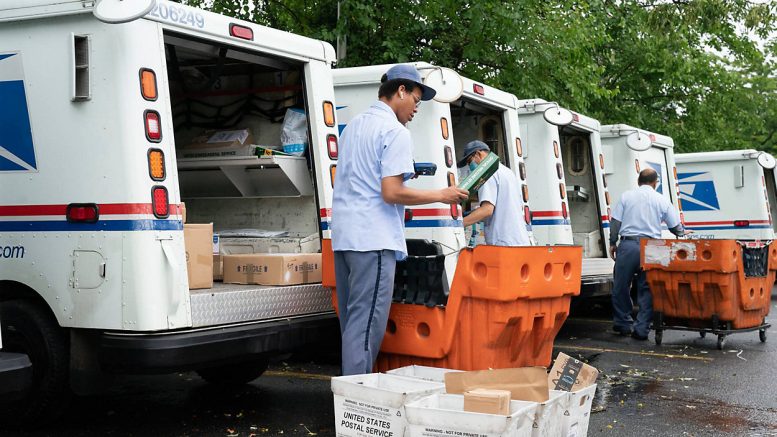
Spectrum News: Talk about snail mail!
Spectrum News tested the U.S. Postal Service’s ability to meet its own standards for delivering local mail. More than 40% of the hundreds of letters sent to local addresses in the investigation were delivered late.
“The Postal Service is facing a number of challenges, and the ripple effects are felt in a lot of places,” said Elena Patel, a senior fellow at The Brookings Institution.
The Postal Service handles more than 100 billion pieces of mail every year, but that’s only half the mail it delivered 20 years ago. Email and private delivery companies like Federal Express have been eating into its business and revenue. To save money, the Postal Service embarked on a 10-year restructuring plan in 2021, but the overhaul has triggered an increase in complaints about late mail.
With roughly 1 in 5 Americans expected to cast ballots by mail in the November election, Spectrum News decided to put the Postal Service to the test, mailing letters across the country and tracking them to determine whether the USPS is meeting its basic service standards, listed on its website, of delivering local, first-class mail within two business days.
Spectrum News journalists in Washington, D.C., and eight states — New York, Ohio, Kentucky, Missouri, Alabama, Michigan, Wisconsin and California — took part in the investigation.
Five Spectrum News journalists spread across each region mailed one envelope to each other every day for five business days. Each envelope was supposed to be mailed by 10 a.m., dropped into the collection slot inside the local post office. Of the 225 envelopes mailed, 213 met those requirements. Eighty-nine of those 213 envelopes took longer than two business days to reach their destination, a failure rate of 41.7%. New York had the best on-time performance, with a failure rate of just 4.5%. Alabama had the worst record in our test; 88% of the mail there was delivered late.
Several letters were delivered long past the two-day standard. Three letters in Alabama took seven business days to reach their destinations. One envelope in Washington was delivered after nine business days. Michigan and Ohio each had one envelope take longer than seven business days.
Patel said the Postal Service is handcuffed in its ability to respond to the twin challenges of falling revenues and rising costs. Unlike private sector companies, the USPS is not allowed to raise stamp prices on its own or borrow money from banks to cover any shortfalls.
A centerpiece of the Postal Service’s 10-year reorganization plan is an initiative known as “Regional Transportation Optimization,” or RTO, which ended afternoon mail pickups from 15,000 small and rural post offices so far, with thousands more expected to be affected.
“If you drop off your mail in the middle of the day at noon or you’ve just missed the morning truck, it used to be that a second pickup was going to come and potentially get your mail and take it for processing that day or night,” Patel said. “Now it has to wait until the next day and the next truck.”
The Postal Service says RTO enables mail processing machines to run more efficiently, but it also means more circuitous routes and longer delivery times.