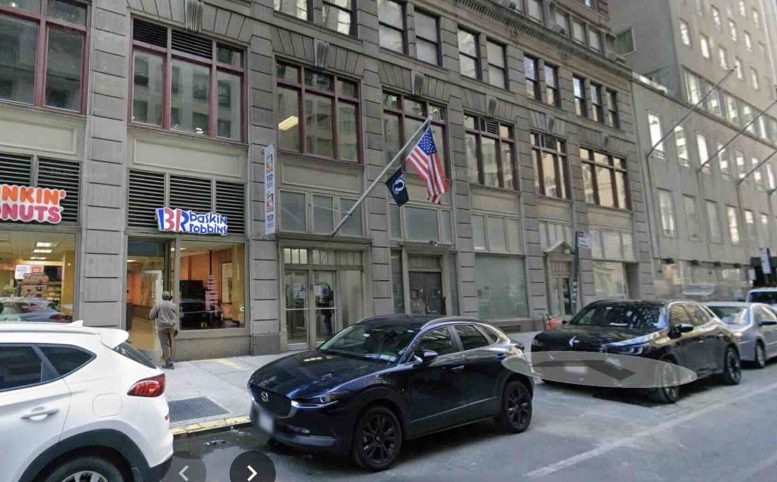
On July 9, the Postal Service announced that the Bryant Station Post Office at 23 West 43rd Street in Manhattan would close at the end of business on August 8. The notice simply cites a “loss of lease” as the cause, adding that “a timeframe for a return to Bryant Station has yet to be determined.”
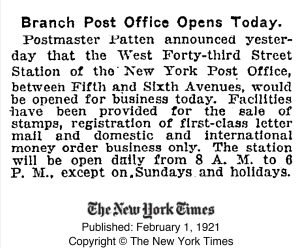
The Bryant Station post office has served Midtown Manhattan at this location for more than a century. The Postal Bulletin indicates that a station was established on West 43rd Street on February 1, 1921. Originally known as West Forty-Third Street Station, it was renamed Bryant Station on February 1, 1947, reflecting its proximity to Bryant Park, which honors poet, abolitionist, and New York Evening Post editor William Cullen Bryant.
At the end of the week, this deep-rooted history in the Midtown community will come to an end, but not without protest and controversy.
On July 28, the members and supporters of NY Metro Postal Union/APWU Local 10 rallied in front of the James A. Farley Post Office on 8th Ave as part of a part of a Day of Action to stand up against corporate attacks on public postal services. The rally also called attention to the pending closure of Bryant Station.
The announcement of the closure also prompted an immediate backlash from New York’s congressional delegation, including Representative Jerry Nadler and Senators Chuck Schumer and Kirsten Gillibrand.
In a sharply worded joint letter to the Postmaster General, the lawmakers called the closure “unilateral and done with zero public transparency” and “handled completely behind closed doors without community town halls or feedback.”
Discontinuance vs suspension
The lawmakers’ letter poses a series of question to the PMG and asks him to reply by July 31. At this time, the response has not been made public, but one can anticipate what it will most likely say:
Bryant Station is not being permanently discontinued, and the closure is not governed by the legal requirements of 39 USC § 404(d), as set forth in 39 CFR § 241.3. (These policies and procedures are spelled out in more detail in the USPS Discontinuance Guide, Handbook PO-101.)
Instead, the office is being placed under an emergency suspension while the Postal Service decides what to do. That could include discontining the post office or looking for another location at a time “yet to be determined.”
For customers, the distinction between discontinuance and suspension means little — either way, the post office is closed. Legally, however, the difference is significant.
A discontinuance requires a 60-day advance public notice, a public comment period, a community meeting, a formal written decision, and the right to appeal that decision to the Postal Regulatory Commission.
An emergency suspension, on the other hand, can be imposed on very short notice, with no public input and no right to appeal.
Section 241.3 specifically recognizes lease cancellations as one circumstance that may require an emergency suspension when no suitable alternate quarters are immediately available. But the regulation also states that when “it is anticipated that a lease or rental agreement will be cancelled,” the Postal Service is supposed to begin studying a possible discontinuance early enough to allow “a meaningful opportunity for public input.” In this case, that hasn’t happened.
Long-standing suspensions
The Postal Service has a long history of avoiding the procedural requirements of a discontinuance by suspending post offices. The regulations impose no deadline for making the decision to relocate or discontinue, and post offices sometimes remain in the limbo of suspension for many years.
Some long-suspended offices eventually reopen, but it’s rare. A recent examination of 506 suspensions more than two years old revealed that only 19 reopened — about four percent. The rest were permanently discontinued.
The problem of unresolved suspensions has long been a subject of concern for the Postal Regulatory Commission, which maintains a dashboard to track suspensions. The USPS Office of Inspector General has issued reports on it as well, and Congress sometimes considers bills about the problem. (There’s more about suspensions on our own dashboard here.)
In explaining why it didn’t follow Section 404(d) when it closed Bryant Station, the Postal Service will invite more scrutiny of this long-standing problem of using suspensions as de facto discontinuances. In this case, though, we’re not talking about the kind of small rural post office that usually gets the suspension treatment. We’re talking about a very busy post office in the middle of Midtown Manhattan.
The lease issue
In their letter to the Postmaster General, the lawmakers begin by questioning the “loss of lease” issue: When does the lease expire? How long has USPS known about that date? Is the landlord refusing to renew, or did USPS choose not to renew? Was an extension pursued? If USPS declined an available renewal option, why?
The date of the lease expiration is itself not a mystery. A USPS facilities report from a few years ago indicates that the current 10-year lease expires on August 31, 2026. That may explain why the Postal Service chose August 9 as the last day of service. This will provide a few weeks to remove equipment before vacating the space.
The lawmakers’ letter does not discuss the property itself, but it’s worth examining.

National Association Building (Source: Metro Manhattan)
Bryant Station occupies a space on the 43rd Street side of a through-block commercial building constructed in 1920 (the year before the post office took occupancy). On the other side of the building, at 28th West 44th Street, is a 22-story office tower. Originally named the National Association Building, it is now known as the Club Row Building because it shares the block with the Harvard Club, Penn Club, and New Yorrk Yacht Club.
Since 2011, the property has been owned by APF Properties, which also has its headquarters in the building.
In 2025, APF defaulted on a $180 million commercial mortgage on the property, and Wells Fargo filed a pre-foreclosure action. The financial distress followed the bankruptcy of WeWork, which had occupied several floors before vacating the building after going bankrupt in late 2023.
This article originally suggested that the foreclosure activity may have had something to do with the Postal Service not renewing the lease, but that’s not the case. Here’s the story as it was related to Save the Post Office by Kenneth Aschendorf, co-founder of APF, after this article first appeared.
APF’s leasing representative spent two and half years negotiating a lease renewal with JLL, the Postal Service’s real estate management company. APF made it abundantly clear that it wanted the post office to remain as a tenant, and it made several significant concessions to accomplish that. Negotiations appeared to be moving along, but then on July 9 the sign went up at the post office saying it would close on August 8.
This was how the owners of the building first learned the post office would be closing. They were as surprised as anyone, including postal employees and customers. The owners have contacted JLL, USPS real estate representatives, and the Postmaster General in hopes of finding a way to keep the post office open, but they have gotten no response. The Postal Service says it will be removing its equipment, signage, etc., by the end of August, when the lease ends.
In June, given how long it was taking to make a renewal deal, the owners became concerned about losing their tenant, so APF listed the post office space for lease with KSRNY, Loopnet and Crexi. But the owners would still like to see the post office remain in the building. They recognize that thousands of businesses and residents depend on the post office, and they have no desire to see it close after 105 years. As of August 3, the space is still available for a lease renewal.
No public process
In their letter, the lawmakers next turn to the public process. They ask when USPS decided to close Bryant Station, when the public was notified, whether any opportunity for public comment was provided, whether the public received instructions for submitting comments, and whether USPS made any effort to engage the community before announcing the closure.
Those questions track the discontinuance regulations, point by point.
Aside from the date USPS made its decision internally, most of the answers to this set of questions are already apparent. The public notice is dated July 9, and no opportunity for public comment was provided. The Postal Service will almost certainly respond that none was required because Bryant Station is under emergency suspension rather than a discontinuance study.
Effects on community, employees, and postal services
The lawmakers’ letter goes on to ask whether USPS analyzed the effects of the closure on customers, employees, and mail service, and what plans exist to maintain the same level of postal service after August 8.

APWU Rally on July 28 (Source: NYC Central Labor Council)
Again, those are factors USPS must evaluate during a discontinuance study, and the Postal Service is likely to respond that considering these effects is not required before imposing an emergency suspension.
The Postal Service notice says that customers may obtain services at Midtown Station, Rockefeller Center Station, or Grand Central Station. In terms of miles, these other post offices are a relatively short distance away, but most customers will not find any of them very convenient.
Walking from Bryant Park to any of those locations means navigating some of Midtown Manhattan’s most congested pedestrian corridors, particularly during lunchtime (the busiest time at these post offices). Office workers, tourists, delivery cyclists, food carts, and crowded intersections make what appear to be relatively short walks considerably more difficult.
Grand Central Station, at 450 Lexington Avenue, is roughly a ten-minute walk requiring pedestrians to cross Fifth, Madison, and Park Avenues and then going up to a second-floor retail counter. Rockefeller Center Station, at 40 West 51st Street, is about a twelve-minute walk through one of the city’s busiest tourist districts. Midtown Station, at 223 West 38th Street, lies roughly fifteen minutes away in the heavily congested Garment District.
Making these walks round-trip during business hours, perhaps carrying packages, will be difficult for the customers of Bryant Station, and it will cost nearby businesses time and money.
The possibility of relocation
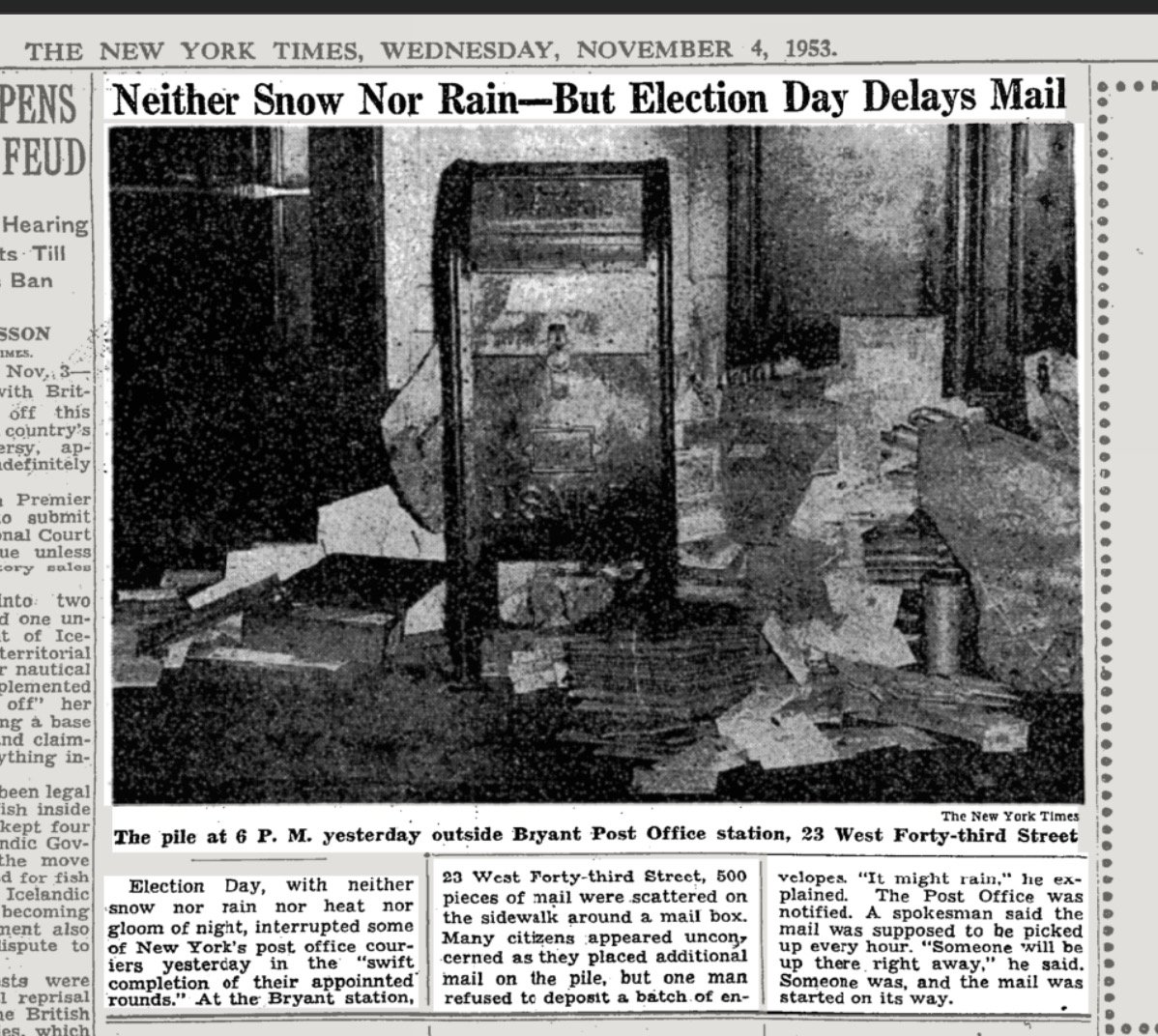
Finally, the lawmakers ask the question that may ultimately matter most: If the 43rd Street office closes, does the Postal Service intend to relocate Bryant Station elsewhere, and if so, when?
The public notice offers only the vague assurance that “a timeframe for a return to Bryant Station has yet to be determined,” and it would not be surprising if the Postmaster General has little more to say.
It is entirely possible that Bryant Station will remain suspended for several years before the Postal Service either identifies a replacement location or begins formal discontinuance proceedings. Perhaps, though, with pressure from elected officials and the community, Bryant Station will avoid this all-too-familiar fate.
— Steve Hutkins
(Photo: Google Street View)
Note: This article was updated on August 3 with additional information provided by the owner of the building.